The Suds of Kilimanjaro

My latest on GlobalPost.com.

Tha Drinkin' Club

DAR ES SALAAM, Tanzania — A night out in this Indian Ocean port city requires a few essentials. A deep-fried dinner of crispy french fries and dripping grilled meat. A club full of sweating bodies. Some thudding Bongo Flava, Tanzania’s version of hip-hop.

And beer. Lots and lots of beer.

Beer is a big deal in Tanzania. And it’s not only a social lubricant, but also a source of national pride and a pillar of the economy. In fact, this summer, the suds have been at the center of a high-profile legal row — dubbed the Beer Wars in local media — about ownership of the two biggest local firms. At least one company executive has been quoted saying the dispute is of national importance. Continue reading…

Note: see correction from below.

Multimedia: Eid al-Fitr in Zanzibar

U.K. and Kheiry

These young Zanzibari men go by the names of U.K. (left) and Kheiry. They’re dressed up for Eid al-Fitr festivities last week. Read, watch and listen to my multimedia report on GlobalPost.com.

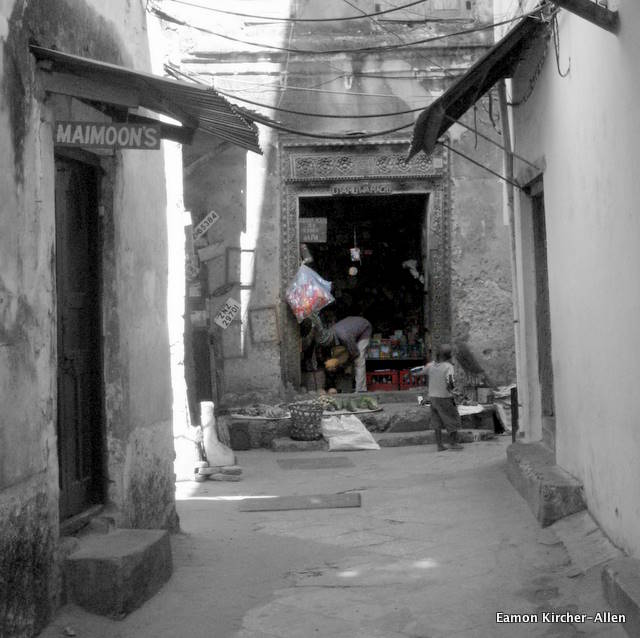
ZANZIBAR, Tanzania — The morning of Eid al-Fitr broke in the narrow streets of Stone Town, Zanzibar, with a few minutes of intense tropical downpour. It was a fitting start to a day that celebrates the closing of the holy month of Ramadan — a day when everything should be clean and refreshed.

Stone Town, or “Mji Mkongwe,” as it is known locally in Swahili, is the oldest section of the main city on the island of Zanzibar, Tanzania. It has lain at the crossroads of vast Indian Ocean trading networks since ancient times. Today, it is a hub of Swahili culture, which thrives on the eastern coast of Africa, stretching from Somalia to Mozambique. With influences from mainland Africa, Arabia, Persia and India, the enclave’s people, architecture and customs capture the eclecticism of Islamic life. Continue reading…

“Confession” from Darfur group: violence was exaggerated

Al Jazeera English reported a few days ago that “a group of former Sudanese activists” had called a press conference to admit that they had exaggerated their claims of deaths and violence in the Darfur war.

A group of former Sudanese activists says some of the figures of those reported dead and displaced in the conflict in Sudan’s western Darfur region were exaggerated. The former Darfur rebel activists told Al Jazeera that they increased tolls and gave false evidence during investigations conducted by delegates from foreign organisations into the conflict.

“We used to exaggerate the numbers of murders and rapes,” Salah al Din Mansour, a former translator with World NGOs in Darfur, said

“Darfur groups ‘padded’ death tolls, Al Jazeera English, September 10, 2009

Regular readers of this blog will know that I have frequently criticized the distortions of the Save Darfur Coalition, which has sloppily exaggerated or misconstrued the scope, causes and duration of the conflict, not to mention advocating a military solution that I disagree with. Continue reading

Bridging the book divide in southwest Tanzania

My audio slideshow and article on a book donation in southwest Tanzania is up on GlobalPost. Click through to check it out — I think the slideshow is the best part.

DAR ES SALAAM and TUKUYU, Tanzania — In the United States, students may complain about the cost of textbooks, but at least they can buy them. In many poor parts of the world, books are simply unavailable — at any price.

For 48 schools in rural southwest Tanzania, that will no longer be a problem. On Aug. 21, teachers and school children here celebrated the arrival of more than 4,000 boxes of books and supplies, donated by American schools, teachers and libraries. As a result these Tanzanian schools will have small libraries for the first time.

The Tanzanian schools are benefitting from a simple plan. Used books that were going to be thrown away in the U.S. are instead sent to Africa. It was organized by the U.S. Africa Children’s Fellowship (USACF), which has completed nine similar donations to Zimbabwe since 2003. Continue reading …

Beaming students

There are certain things Fresh, and certain things مش

This would fall into the former category. “Africa’s rap Bruce Lee” has struck again: a free digital mixtape featuring K’naan rhyming to the music of Fela Kuti. It’s a collaboration between K’naan and J.Period, the first episode in a project called The Messengers that will apparently include K’naan alongside the likes of Bob Marley and Bob Dylan.

On one track K’naan explains that these guys are the secular equivalents of Jesus and Mohammed, رسل الله — Messengers with a capital M. His juxtaposition to the greats on the (very cool) cover art may not be a declaration of humility, but these are some nice tracks.

Download the album here at 2dopeboyz.

Context be damned: reactions against Saviors and Survivors from the R2P camp

As an eighth-grader learning about American slavery, I had a fantasy. I imagined that some elite Marines and I could outfit ourselves in the latest combat gear and travel back in time to the year 1820. Once we arrived in the heart of the slavery era, we’d storm the plantations with superior weaponry and free the slaves. Problem solved. It would be awesome, and I’d be a hero.

Of course, as I learned in later study, the abolition of one of history’s most monstrous atrocities was not such a simple matter. Dismantling slavery meant the splitting of a nation, a civil war that sacrificed 600,000 lives, and a burning of the South that – while possibly justified – entailed extreme and morally repugnant violence. And of course, war was only part of the solution. There were the complex political negotiations, the recalibration of society that, 150 years later, is still incomplete.

I kept thinking of these episodes in my education as I read Richard Just’s August 27 take-down of Mahmood Mamdani in The New Republic. The article – a review of Mamdani’s Saviors and Survivors and Gareth Evans’s The Responsibility to Protect – concludes that Mamdani’s book is a paranoid failure, but that Evans proposes a refreshing idealism (though Just finds that the R2P proponent is a little too conservative in promoting his doctrine).

Continue reading

Tanzania’s huge foreign aid flow

During my daily perusing of the Save Darfur Accountability Project (a funny, irreverent and important blog that I urge you to add to your RSS feeds), I saw this graphic of the top world aid donors and recipients. SDAP’s post is intended to show that, contrary to Save Darfur’s arguments that the United States is neglecting Sudan, Washington actually gives more aid to Sudan than any country besides Iraq and Afghanistan. Here’s the image, originally from visualeconomics.com:

Point well taken. But what also caught my eye is that peaceful and stable Tanzania receives, according to this graphic, more development aid than any at-peace country in the world.

Without discounting the basic lacks that lie behind the build up in aid, I have to wonder what that does to an economy and to a society. (Why do I keep having images of Bone Thugs-N-Harmony’s “First of the Month” video, about minute 2:30, flash through my head?) I also have to wonder how much of that money goes to buy these NGO-logo-emblazoned Landcruisers tooling around Dar es Salaam and depositing people at fancy hotels for overpriced drinks.

Anyone know where I can get copies of Dead Aid and The White Man’s Burden in TZ?