Making sense of Mortenson

All day long I have been utterly fascinated with the revelations about Greg Mortenson’s falsehoods and mismanagement of his organization, the Central Asia Insitute, which he created to build schools in Afghanistan and Pakistan. I vowed to write a lengthy essay tonight to get out all the thoughts this episode has provoked — but it’s 1:00 AM and I still haven’t finished the esteemed Jon Krakauer’s 75-page exposé, “Three Cups of Deceit: How Greg Mortenson, Humanitarian Hero, Lost His Way.” Thus, I offer just a few disjointed comments, pending my completion of the article and, ahem, the book.

First, let me suggest a partial reading/watching list, which my Twitter feed should continue to augment in the next few days:

  • Ideally, at least one of Mortenson’s books, especially Three Cups of Tea. In fact, I haven’t read them, though they have been recommended and gifted to me on numerous occasions.
  • The 60 Minutes episode from Sunday, 4/17/11.
  • Mortenson’s response in an Outside magazine interview.
  • CAI/Mortenson’s response to 60 Minutes’s questions (I believe they came too late to make it into the program).
  • A blog of the Economist parsing of one of at least two insidiously racist assertions in Mortenson’s Outside responses: that the “archaic” Balti language makes locals unfit to retell the dates of his arrival in their village. As a friend who is an anthropology professor specializing in this region wrote to me: “I find that claim to be rather dubious. Even if their language is an archaic dialect of Tibetan, Baltis have been Muslim for centuries and are presumably well acquainted with the Islamic clandar. Also presumably there would be at least one or two teachers or officials in even the smallest village who would be invested in being modern. Or there would be in China at any rate…”The other insidiously racist passage (and shameless passing of the buck) is Mortenson’s suggestion that there is something called a “confidence trick” in “Africa and Asia” whereby local staff take advantage of donors after years of gaining their trust. While certainly possible, this is not limited to Africa and Asia (dude, I’ve heard about some stuff working for the San Francisco city government, believe you me), and is just a lazy reference to a trope, which is an artifact of colonial times, about the dangers of the wily native.
  • Finally, and most importantly, read Krakauer’s article (downloadable for free for about the next 48 hours). It’s astonishing —  even if I haven’t finished it yet — not least because the CAI/Mortenson fabrications occurred in plain view for a decade and a half.

This affair illuminates an intersection of many social and political issues. It’s about much more than the individual, Mortenson. I’m thinking here of the narratives of GWOT; the fundamental problems with accountability of private nongovernmental work overseas; the unquestioning of the American public when we are spoon-fed facile stories of foreign lands populated with casts of wild-eyed fundamentalists, noble savages, and their helpless babies, who need us oh so much.

More deeply, it makes me suspicious of charity as a solution to complex problems. The violence and inequality in regions such as AfPak — and indeed the world — are political in origin and demand political solutions. To the extent that we can ameliorate problems with charity, without also reforming the power imbalances, laws, and crippled economies beneath them, we sometimes risk simply whitewashing, and we will necessarily create cases like Mortenson/CAI.

And the truly saddening thing is that a lot of evidence shows we want to continue believing fairy tales like Mortenson’s rather than face the difficult necessity of reforming our relationship with the world. A saccharine story and a donation are exponentially easier to digest than the systemic reform that is truly needed for any lasting change.

Take the fan base’s responses to Krakauer and 60 Minutes. Monitoring the comments to the articles above and the #Mortenson Twitter feed, it is easy to see that many, many people are ready to forgive Mortenson, without further ado.

His heart was in the right place. He really raised awareness about the need for education. Sure, some money was wasted, but a lot of it ended up in good places. The media is sensationalist. It’s a beautiful vision.

Please, please, don’t take our easy, breezy bedtime story away from us…
Update on China-TZ relations

The excellent Tanzania-focused blog Swahili Street kindly linked to my last post, and brought my attention to some important updates. Apparently, those tensions I mentioned between Tanzanians and Chinese traders in Dar have reached new heights. Seems the delicate balance has tipped somewhat, at least for now. Please have a read of the well-sourced article here.

Chinatown, Dar es Salaam

Note: I wrote this article about Chinese traders in Dar es Salaam for publication a year and a half ago, and for some reason it didn’t get picked up. I thought it was an interesting subject because China’s involvement in Africa is often discussed from the perspective of its political and global economic implications, when for most of the businesspeople involved in trading, those things don’t really matter. They don’t see themselves as protagonists (or antagonists, as many in the West like to claim) in that kind of a story — they’re just trying to make a buck.

I have a hunch this dispatch is still pretty up to date, but if I’m missing some major change that’s occurred in the last year, please let me know in a comment! Enjoy.

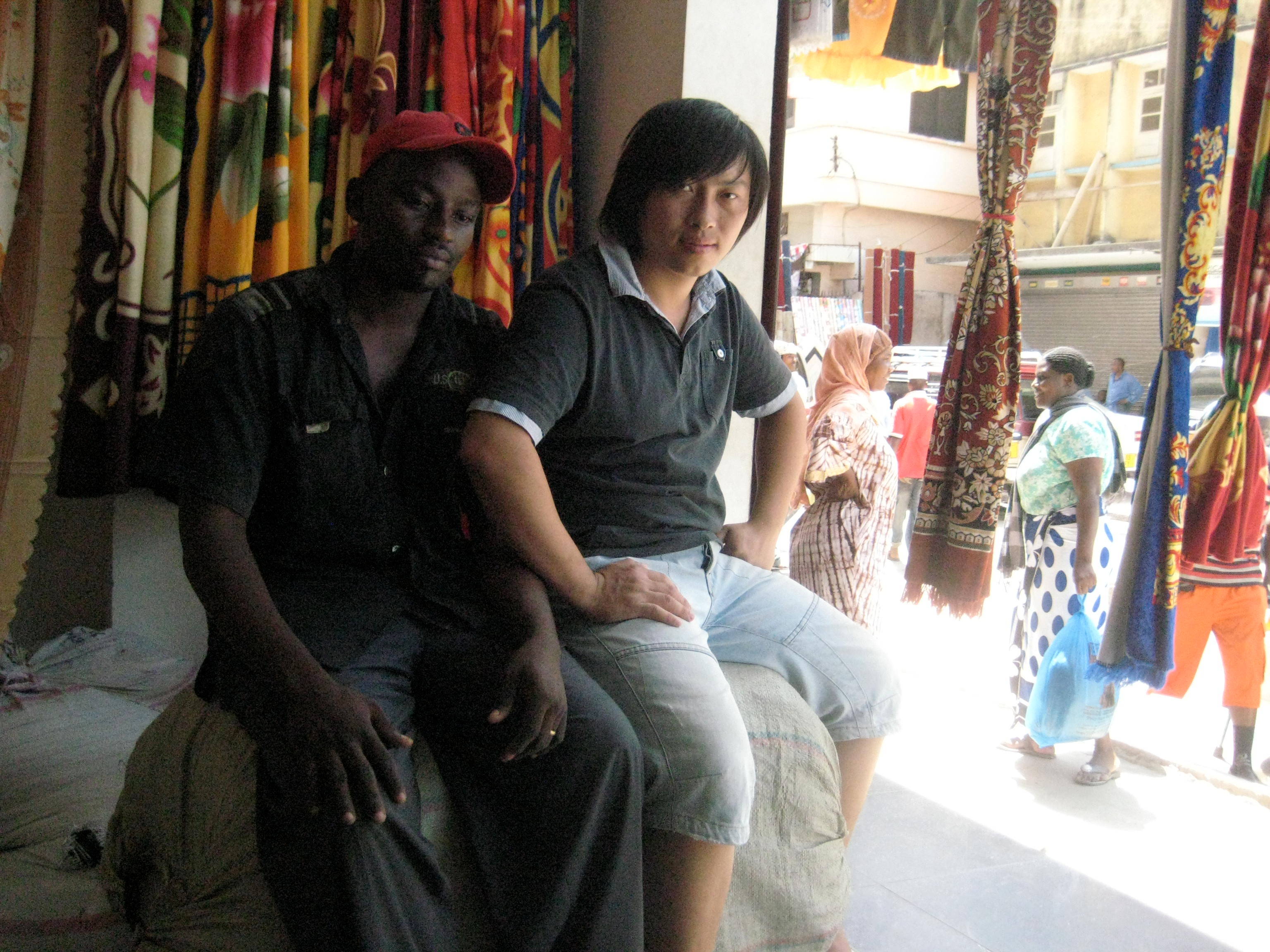
DAR ES SALAAM, Tanzania – Perched on a plastic chair in a wholesale fabric store in a working-class neighborhood here, Tony smiles.

“Most of the time, the local people are right to you,” he says. “It’s good to have different experiences. You can’t close your mind.”

The sanguinity is a little surprising. Tony (birth name Tau Fu, originally from Shanghai, China) has just described watching an armed robbery at the moneychanger’s across the street, his futile attempt to recover lost goods from a burglary at his storage facility, and the memory of another Chinese trader who was shot and killed in another stick-up.

Like many of the other Chinese traders who are arriving in Dar es Salaam and other major African cities, he is focusing on opportunities, not challenges. Mostly young and male, they travel thousands of miles from home to open markets for their cheap, mass-produced goods. They live in poorer neighborhoods than many Western expats but without ties to local communities, and stay for years at a time.

It can’t be easy. And yet they continue to come – more, it seems, every day.

Tony’s story sheds light on the migrant experience. The 27 year-old studied English in college and began working for the Kangxing Trading Company, a textile operation with its own factory. After two years of work, his boss sent him to open a shop in Tanzania, joining Chinese traders who had been opening businesses here since the 1990s.

Drawing on a mix of adventurousness and ambition – he was promoted to manager of his own store – Tony agreed. He arrived in Tanzania as an agent of the company, conducted market research for his boss, and opened up a storefront in Kariakoo, the cheapest area in downtown Dar es Salaam.

Tony estimates there are about 80 other Chinese-owned shops in the neighborhood, and there is a Chinese population big enough to give the area a feeling of an ethnic enclave in its infancy. There are now markets for Chinese food and a few restaurants scattered throughout Dar es Salaam. Chinese workers staff many of the stalls in the seething streets, selling shoes, fabrics and other manufactured goods.

At first glance, the traders have a good relationship with locals. Sitting in doorways, they slap five with passersby and trade jokes. Some speak Swahili better than they speak English. In Tony’s store, a younger Chinese worker and a Tanzanian employee sat on a bale of synthetic curtains and teased each other about their cultures’ differing preferences in women.

But not everything is so cozy. On the one hand, Tanzanians have welcomed the availability of cheap goods. There is also resentment, however. Some say the Chinese have undercut local traders. Their goods do not have a reputation for quality. Some people claim they have driven up rents in the once affordable neighborhood. For their part, some of the Chinese businesspeople feel unsafe. “It’s easy to rob Chinese people, because they’re not local,” Tony said.

In a fish market on the waterfront, local fishmongers trash-talked another Chinese textile trader, a 28 year-old named Ni Je, after he passed their stall.

“Mchina is no good,” a man said, using the Swahili term for a Chinese person. The seller gestured to a huge fish lying on a table. “He wants to buy this for 2,000,” he said, quoting a price in Tanzanian shillings that is a about $1.50.

Ni, who goes by the name Andy when doing business with foreigners, had not even expressed interest in the fish. But the judgment had been passed.

Ni says he doesn’t let incidents like the one at the fish market bother him. After all, he’s here to make money, and there are people who try to bother you everywhere, even back home.

As for the cheapness of Chinese goods in Tanzania, Ni says it is simple economics. “Chinese can produce anything,” he said, but African customers cannot usually afford the higher quality goods. So producers lower costs – and standards – to the point where the goods will have a market in countries like Tanzania, where 96.6 percent of the population lives on less than $2 a day, according to United Nations figures.

The first significant numbers of Chinese arrived in mainland Tanzania in the 1960s to build a railroad. Later, China sent doctors and invested in other big-ticket construction projects. At the diplomatic level, the countries enjoy friendly relations. In 2008, Tanzania was the only African country through which the Olympic torch passed during its round-the-world relay.

China’s presence in Africa is controversial. While African leaders like Paul Kagame of Rwanda have hailed Chinese investment in Africa, Western rights groups have criticized China’s business-first relations with alleged rights abusers like Sudan and Guinea.

For the smalltime businessmen in the streets of Kariakoo, though, the focus is much more immediate: a dollar earned, a rung climbed in the ladders of their careers.

As Ni put it, “Chinese people like to work – whenever, wherever, we don’t have a problem.”