Over the last two days I took the beautiful ride throught the verdant Usambara mountains of Tanzania to Tanga, and then on to Mombasa by way of a scraggly coastal road: red dirt, thatched villages in stands of coconut palms that looked like they could have been transplanted from Fiji, stout lonely baobabs on the hilltops. Continue reading
Author: Eamon
What do Lil Wayne, Jesus Christ and the Holy Qur’an have in common?
Not much! Except that a guy was selling posters of all three on a sidewalk near Kariakoo the other day. Also, check out the awesome Rambo bag distributed at the local vegetable market.

"You could love me or hate me/I swear to God it won't make me or break me..."

It's like they finished designing this bag and thought, "Crap, we didn't include any cpoyright violations. What can we slap on here?"
Experimenting with a new look…
Feedback most welcome. I want a sleek look, easy on the eyes, distinct without being distractingly so, a nice header that is also not distracting. Of course, the most important thing is that you can read it easily!
Obama prize: for the people
My initial reaction was, like so many Twitterers and Facebookers, “It’s too early.” Obama has not nearly dismantled the GWOT to the degree I want to see, he’s still presiding over two specific wars, he hasn’t taken a position on the Goldstone report or condemned the bombing of Gaza or Israeli nukes, he may send many more troops to Afghanistan. My expectations are high, and there’s too much about American policy that continues to reek of war and imperialism.
But as a day has passed, I’ve grown more and more excited about his award. One person whose opinion I greatly respect prodded us on Twitter:
“It’s the height of cynicism, and the triumph of punditry, to scoff from the sidelines at President Obama’s Nobel Peace Prize.”
I don’t think all the negative reactions to the award from the left have been simple, sarcastic scoffing. Many are related to the continuing hugeness of the American war machine, the missile strikes on civilians in Afghanistan, the failure to satisfactorily shut Guantanamo.
Writing about Africa: who will hold you accountable?
I’ve been reading some interesting stuff on a mini-scandal involving a guy who was quoted in several news reports as being a spokesperson for Darfur refugees. Turns out the man, who went by the name Abu Sharati (clearly a nickname, though never noted as such in the stories), was actually probably a spokesperson for a rebel group. Read the whole discussion through these posts and their links (I’m pasting straight from my Twitter feed because I’m writing this from a net cafe): via @SBengali http://bit.ly/GPQOY & @robcrilly http://tinyurl.com/y8rhy9h.
Now, I’m truly sympathetic to the pressures that international journalists are under, their limited resources and their need to rely on sources like “Abu Sharati” because there is no time and no way to look for anyone better. In my brief foray into journalism, one thing I’ve immediately seen is that it is vastly easier to criticize media than it is to report. But the fact that this error was caught is really important. Some hedging language should have been used in the original reports. The revelation will, I hope, promote more caution in the future.
But there is a deeper issue that this discussion points to: reporting about people who will not read your work and do not pay for your stories (indirectly or directly) means there are fewer incentives for good fact-checking. There is a structural paradox at the core of international journalism, especially in Africa: our American audience’s preceived lack of proximity to the stories we produce makes it (that audience) passive about the information it receives. Continue reading
Fixin’ to be a long gone daddy
Just a quick update from an Internet cafe in Kisutu, Dar es Salaam. I’ve been off the net this week and spending my time getting lost on public transit and trying to meet interesting people, while taking breaks to pay too much for impulsive purchases in he street, like a Lucky Dube double disc of dubious origin (most of the writing is in Chinese on the cover) and a pair of leather sandals. (Every country has some product you can’t leave without acquiring, the sandals have got to be that for here.) Those modest plans have been going pretty successfully. Continue reading
Music break: “ninafeel so nice”
I’ve been wanting to do some more substantial blogging, but busy and the internet connection is not as fast as it should be (ironically, in these net-boosting times, which I have helped contribute to: East Africa gets connected to fiber optics).
So, while you’re patiently waiting for me to say something of earthshaking importance, a little treat. Sauti Sol is from Kenya. Here’s their multilingual hit track, “Lazizi,” which sings about a date of coffee drinking and gazing into each other’s eyes. Notwithstanding that Kenya apparently drinks only 2 percent of the coffee it produces, partly because of some archaic colonial-era laws (hat tip to @coldtusker on Twitter for alerting me to that piece), I am digging this song. Especially the Luhya part (go figure), which is the second verse. Feeling good about going to Kenya soon. Enjoy.
PS, did you catch that Sheng in the title? I’m not speaking Swahili yet, but love that inventiveness.
Hat tip, LL.
The Suds of Kilimanjaro
My latest on GlobalPost.com.

DAR ES SALAAM, Tanzania — A night out in this Indian Ocean port city requires a few essentials. A deep-fried dinner of crispy french fries and dripping grilled meat. A club full of sweating bodies. Some thudding Bongo Flava, Tanzania’s version of hip-hop.
And beer. Lots and lots of beer.
Beer is a big deal in Tanzania. And it’s not only a social lubricant, but also a source of national pride and a pillar of the economy. In fact, this summer, the suds have been at the center of a high-profile legal row — dubbed the Beer Wars in local media — about ownership of the two biggest local firms. At least one company executive has been quoted saying the dispute is of national importance. Continue reading…
Note: see correction from below.
Multimedia: Eid al-Fitr in Zanzibar

These young Zanzibari men go by the names of U.K. (left) and Kheiry. They’re dressed up for Eid al-Fitr festivities last week. Read, watch and listen to my multimedia report on GlobalPost.com.
ZANZIBAR, Tanzania — The morning of Eid al-Fitr broke in the narrow streets of Stone Town, Zanzibar, with a few minutes of intense tropical downpour. It was a fitting start to a day that celebrates the closing of the holy month of Ramadan — a day when everything should be clean and refreshed.
Stone Town, or “Mji Mkongwe,” as it is known locally in Swahili, is the oldest section of the main city on the island of Zanzibar, Tanzania. It has lain at the crossroads of vast Indian Ocean trading networks since ancient times. Today, it is a hub of Swahili culture, which thrives on the eastern coast of Africa, stretching from Somalia to Mozambique. With influences from mainland Africa, Arabia, Persia and India, the enclave’s people, architecture and customs capture the eclecticism of Islamic life. Continue reading…
Back from Eid al-Fitr in Zanzibar
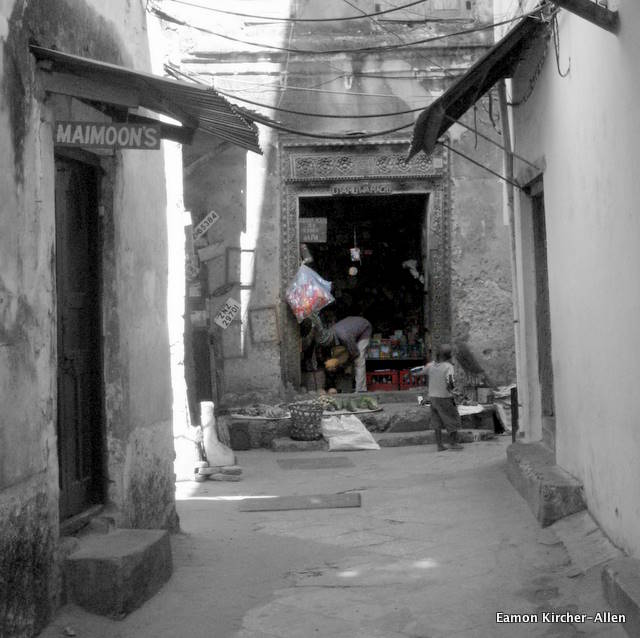
Just a slightly doctored image from my four-day sojourn in Zanzibar covering Eid. I know the focal black and white thing is a bit gimmicky, but I thought it worked here.
Internet is down in my hostel (man, I have gotten so spoiled), so new LGD posts will be a bit intermittent for the next few days. Please bear with me. Eid Mubarrak!
 Eamon Kircher-Allen