My friend Willow made this clip during a summer in the West Bank. I’m really impressed. Makes me want to be a new media booster — with just a little bit of training and relatively inexpensive equipment, anyone can be an effective documentarian.
Author: Eamon
A Space Station Called Dubai
I have come to think of Dubai as a space station: a place-less city in the middle of nowhere whose semblances of community, culture and soul are imported at great expense from elsewhere. The malls, bars and restaurants are of high enough quality to give the illusion of location, but the heart feels far away from earth.
Michael Slackman put it perfectly in this excellent Times article from today: “Dubai has been built along roadways, 6, 12, 14 lanes wide. There was no central urban planning and the result is a city of oases, each divided from the other by lanes of traffic. The physical distance between people is matched by the distance between nationalities. Dubai has everything money can buy, but it does not have a unifying culture or identity. The only common thread is ambition.”
One of the reason’s Slackman’s article is great is that it shows the positive side of Dubai from an Arab perspective: finally, there is a place where young Arab men can get paid, and their ability to work is respected. That’s a good thing. The dynamics Slackman describes are exactly those I observed talking to Palestinians who are now working in Dubai, having left the various countries of their diaspora. I was happy to see some of my friends finally getting paid like they deserve to be.
On the other hand, Dubai is a major destination for human traffickers, and the situation of the indentured South Asians of the labor camps is none too encouraging. Neither are the relationships between Western or richer foreigners, Arabs and South Asians. From what I observed in a brief four days, these groups didn’t mix a whole lot, and the comments tossed around by some Arabs about South Asians are hard to swallow. The men-to-women ratio is out of control. (An omission of Slackman’s article is an explanation of why he only interviewed men.) There’s a lot lurking below the surface.
That’s why I see the positive sides of Dubai not so much as a triumph of that bizarre, binging city, but more as a reflection of just how bad things are in the rest of the Arab world. There are no good reasons why the same opportunities cannot exist, in their appopriate contexts, in places less artificial than Dubai. What’s more, Dubai cannot sustain the whole region indefinitely.
Anyway, the story of Dubai is still unfolding, and I don’t think anyone knows what the phenomenon really means yet. Glad to see good reporting on it.
Financial Crisis: Quotes from a Columbia classroom
The last couple days have shown that there are fundamental problems with the way we finance everything in this country. David Leonhardt’s column in the Times is a thoughtful summary of the long-term changes that need to take place to make sure this doesn’t happen again. No bailout, he writes, can solve the problems of regulators thinking Wall Street can police itself, or households taking out “wishful-thinking loans” they can’t afford.
While no one official has put forward a new long-term financial strategy, people seem to be agreeing about some fundamental issues in this crisis. (And some of them were saying these things years ago. Why didn’t more people listen?)
Here are some comments from a lecture by a professor teaching a class in international finance at Columbia University. I’m not naming the prof, since the classroom — even though it is effectively open to the public and had about 150 students — is only a semi-public place and not a press conference, but I’m sure plenty of folks will find these comments interesting. This prof has years of experience in the finance world.
- “The last time I felt like the bottom was falling out [like this] was October 19, 1987.”
- The roots of this crisis were ten years ago. Despite all the complex balance sheets that seemed to cover risky debt, something was ignored: “There is a fundamental concern that if you want to sell something [debt], it means you don’t want it anymore.”
- What people thought about Bear Stearns: “These balance sheets look suspicious, but you know, they [Bear Stearns analysts] are just so smart! But then they play 20 straight days of golf and smoke marijuana in public …. Hmm, maybe they’re not so smart.”
- “These guys [i-banking leaders] are not that smart, they’re not in touch and they don’t know what they’re doing.”
- Bear Stearns has been hyped as a bailout more than it actually was. “The press calls it a $29 billion bailout. But … it’s not obvious that the Fed is going to lose money on this.”
- “A world without i-banks: is it one we want to live in? I have personally thought for a long time that the existence of these banks is fraught. Individuals can trade stocks without Lehman. Investment management — you can get that without Lehman…. Sales and trading — that’s why God created hedge funds. They have built-in incentives, they are unregulated and the investors can afford to lose.” [LGD aside: Not sure I agree with this last one, but I don’t know enough yet to argue with someone who has decades of experience.]
- “These behemoth i-banks combined all these things under one roof. Not only did they breed conflicts of interest, they are hard to manage — look at the changeover of leadership.”
- “I don’t know why AIG insured so many subprime loans. My guess is that when they first did it, it made a profit, and they continued. It was a titanic error of judgement.”
- “I predict that Goldman will be bought by the end of the year…. But maybe they’re so special that they’re really unique.”
- “I kind of think it’s a good idea to have fewer stand-alone i-banks, but I don’t think they should all go down at once like this.”
REGULATORS…. Mount up!
We need a fiscal Nate Dogg and Warren G to take control of these wild days on the Street.* But this time they need to be on Wall Street, not 21 and Lewis.
I have to admit to feeling a kind of sick glee watching the coverage of Lehman’s demise this week, and I’m not alone. Wall Street observers are saying this is a necessary step in realizing the full depth of the financial crisis.
Of course, the glee is unfounded, right? Isn’t it terribly naive to feel this way, since this crisis is going to rattle the economy thoroughly, and eventually directly affect me, along with everyone else?
The thing is, the Lehman disintegration is just a symptom of a crisis that has been brewing for much longer, so the glee is more about the depth of the crisis coming to light, and not about all the lost money.
Also, while I feel sorry for anyone who lost jobs or big money in the last few days, this is something of a case of the chickens coming home to roost. Long before summer 2007, I heard stories of people piling into houses in poor neighborhoods to try to pay their way out of subprime mortgages and keep their homes. Meanwhile, the hot housing profits in the credit markets were built on the use of these mortgages and the derivative schemes that made them seem viable. The geniuses in private equity who came up with these ideas operated outside the constraints and oversight of regulation — I guess because the government trusted them, as rich people (rich=competent and good, right?) and because no one fully understood the mechanisms they were using. Now, the house of cards has collapsed.
It goes without saying, at this point: These capital markets need regulation, just like any market where greed can trump prudence. Which is probably any market under the sun.
So as soon as the bailouts and bankruptcies blow over, we need action from lawmakers, preferably under the guidance of a president who is not an idiot.
Regulators, mount up.
*In case you lived in a cave in the early 90s, Warren G and Nate Dogg sang the hugely popular 1994 hit, “Regulate”, in which Nate Dogg describes saving his friend from muggers — “regulating” — on the streets of Long Beach.
Ramadan in My Neck of the Woods
The muezzin’s call rises above the tenements in the deepening dusk. The crowds of faithful hurry to wash, pray and then, finally, to break their fast. The days have been long and warm this Ramadan, but work must continue as usual in this city where a day’s rest from the hustle can mean no food at all.
Nope, this is not a nostalgic Beirut or Damascus flashback. I’m talking about my new place near 117th and Adam Clayton Powell in the heart of Harlem. Around the corner is what must be one of the most vibrant Senegalese neighborhoods in the United States. It’s so dominated by Senegalese culture that Bambara and French are the languages that murmur from the stoops in the night, and men and women often wear their African clothes to hang out in.
My grandfather grew up around here, and used to camp out in Morningside Park with his copy of Peter Pan. I try to imagine that, and think it’s strange and wonderful that the neighborhood has changed so much since then, and I want to find out how it all went down.
Until then, I’ll enjoy the call to prayer. And the immense, $12 plates of lamb and couscous on 116th Street.
NYC: It’s a Family Affair
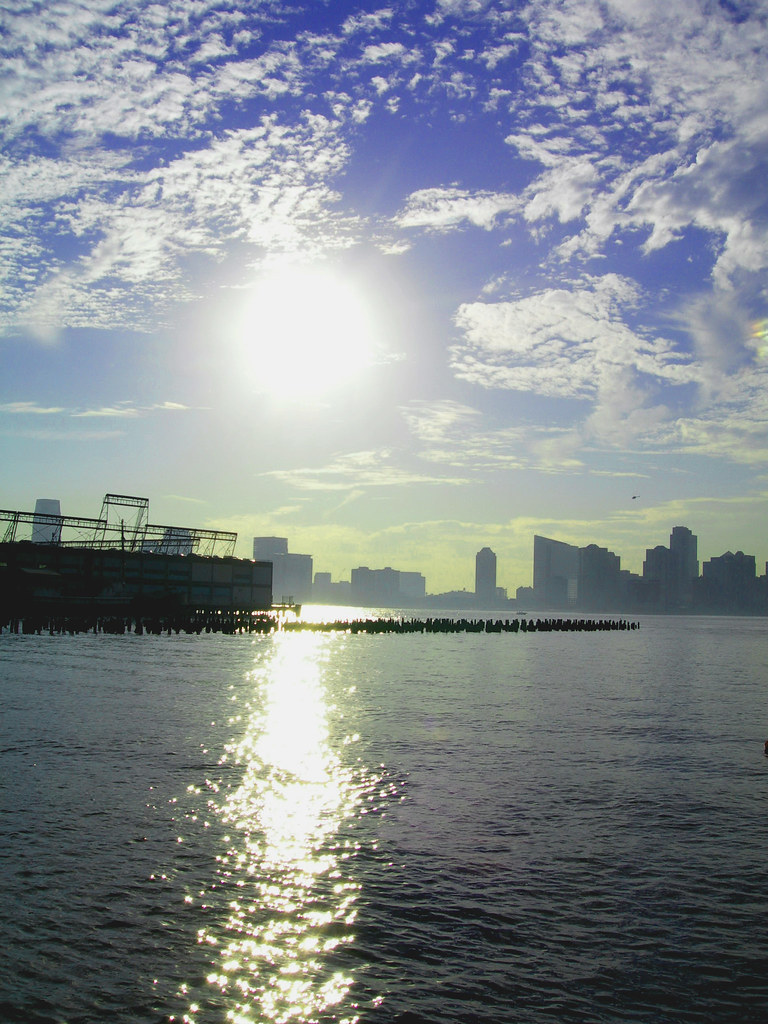 Dear New Yorkers: You’re lookin’ good.
Since I came back to NYC, it’s been about 75 degrees every day with light humidity and clear skies. Everyone looks in particularly good health. The trees are riotously green, though starting to look a little on the wilted side, it being the end of the summer and all. Compared to Beirut, things feel quiet, and smooth-running.
I went down to a park on a pier near Chelsea piers today, sunbathed and people-watched. (That’s the view above, thanks to Llima, who licensed her work on Creativecommons.org; I neglected to take a picture.) I put on my headphones and listened to Sly and the Family Stone sing “It’s a Family Affair” as three New York kids to my left argued over whether the very real grass was fake or not.
And I have to say, with me and NYC, it is now a family affair. Thanks for having me back, city.
The Last Cedars of Lebanon

I’m already back stateside, but I wanted to write a few lines about my visit to Lebanon’s cedars in early August.
When you hear Lebanon, you think cedars. The tree is featured on the Lebanese flag, the cedar forests of Lebanon are mentioned in Gilgamesh — which is the oldest known written story — and any two-bit Beirut tourist shop will have trinkets supposedly carved from cedars. Which is why it is astonishing to see just how few are left. (At least in the main preserve, which is the one I visited. Apparently there is a secondary one in the Chouf that is quite a bit more extensive.)
In the reserve in Mount Lebanon, the cedars are confined to a few acres on a broad, denuded plateau at about 8000 feet. The winding road that takes you to them — with the anticipation mounting all the while — goes straight up from the sea through fantastic villages perched on the sides of chasms whose bottoms lie in shadow. You pass the village of Khalil Gibran — the famous poet who wrote The Prophet, a popular feature at 70s weddings — and churches built improbably on precipices. Bare mountain summits tug on shreds of mist. You’re almost there as the car climbs up through a final ravine…
Suddenly, the car passes through a 30 meter stretch of crammed stalls selling cedar-related tourist goods, and a few stately cedars begin to pop up on your right. Man, you must really be getting close to the forest!
But then you pull out into a treeless plain and there’s nothing in front of you except a bare mountainside with a lonely ski lift floppily hanging to it. Those few stately cedars were the forest. And barring a somewhat spotty attempt at replanting on the road to the entrance of the preserve, all the old trees have been cut down, literally to the edge of the stone wall surrounding the preserve. Inside, there are just enough trees — and some of them truly are sacred, thousand-year-old grandfathers that instill a lot of awe — that you can briefly be tricked into thinking you are inside a forest.

From a vantage point high on the mountain ridge above, however — where I drove afterward — the magnitude of the deforestation is clear. The cedars look like someone’s garden, perched on the lip of a high basin that must have once cradled a mighty forest that seemed inexhaustible to its early harvesters. The deforestation is probably a problem that dates back to ancient times, because there is very little evidence of stumps or the former forest. But based on the topography and climate, and my experience with clear-cuts in North America, it seems pretty clear that the forest was as large as I imagine (though I’d like to get a scientific confirmation).
It is a pitiful sight and one representative of Lebanon in general — so much has been taken from this country’s glory. Only a tiny glimmer remains, just like these cedars. Perhaps it is just barely enough to produce seeds, which if carefully protected could produce another forest of beautiful Lebanese cedars one day. Then again, the grove is also so small that a single catastrophe could easily wipe it out.
The sight of this grove also made me thankful for the systems of public land protection we have in the United States, something we need to continue to protect. We are extremely lucky to have as many national forests, parks, monuments and wilderness areas as we do. Let’s not take it for granted.
The South Wind of Summer Caresses the Hills…

I got a call around noon on Sunday — my last Sunday in Lebanon — from my capoeira friends asking if I wanted to come to the Bekaa to do a workshop for a youth camp.
Duh. Of course I want to go on a road trip with a bunch of capoeiristas to northern Lebanon!
An hour later, I was cruising up the Damascus Road in the back seat of a capoeirista’s jeep with a berimbau lying across the middle of the car. We came to the crest of the mountains and beheld the mighty Bekaa Valley. It was supposedly the breadbasket of the Roman empire, full of grains and fruits for nearly the length of Lebanon. Now, it still produces some of the best fruits, vegetables and wines, but it has been left out of the international trade loop, people say. It is relatively impoverished and development has bypassed it. Parts of it are home turf for Hezbollah. On the far side of this deep, broad valley rise the slightly more arid ante-Lebanon ranges. On their far side — in their rain shadow — lies Damascus.
The view has the same effect as the one that greets you coming over the Grapevine from Los Angeles into the Central Valley of California. You know, the view that Tom Joad sees in The Grapes of Wrath when his Okie convoy finally comes through the Mojave.
A little while later we were heading up the Bekaa listening to Salif Keita. We went through some small farming towns, where the people had a hard-bitten look to them, and there were Hezbollah and Amal flags everywhere. They run the show, and the Amal guys we asked for directions were completely helpful, despite the foreign appearance of even the Lebanese in our six-person group. (Amal is a political party allied with Hezbollah.)
Ahead of us was a thunderstorm: a good, old-fashioned, high-desert, afternoon-sky-blackening thunderstorm. My instructor — who lived in Albuquerque for years — and I immediately knew it was going to be a nice rain. We had a fun time arguing with the Beirutis in the car, whose conviction that rain does not fall in Lebanon in August under any circumstances was stronger than the evidence before them. Finally the blessed drops began to fall, and we stopped the car and greeted the moisture with out-stretched arms. Such refreshment is hard to come by down in Beirut.
We turned up into the hills to the west, and began a slow ascent through mountains that looked exactly like the semi-arid country of southern Colorado. The difference was that here, the soil was limestone, and the trees were not pinions and junipers but olives and other deciduous trees. They grew in the same evenly spaced patterns of a pinion forest. A breeze was blowing and I could smell the rain. I felt right at home.
In a small dale where the road was glistening from the recent rains, we stopped by a cabin where some apple trees were growing. A man in camouflage pants with a pony tail came out of the cabin. Some children and women were in the background.
“Hey, don’t I know you?” he said in clear English, with a decaying smile. He then proceeded to offer us “cocaine, ecstasy, hash — whatever you want.”
“Uh, no, we just wanted some apples,” I said in Arabic.
“Oh, OK, please have some. In the summer, we have apples. But in the winter we have cocaine, ecstasy, hash, only.”
It was a puzzling and light-hearted conversation. We had no interest in his more exotic goods, but we left with our delicious, fresh apples and drove above dark green fields of crops (you read correctly, Cypress Hill fans) to the camp where we were doing the workshop. The picture above was taken on the last leg of the trip, above the little valley where the hamlet is.
At the summer camp, we did drills with everyone in the late aternoon on a large stage. People liked it — the children were most enthusiastic — but their attention was mixed until we played in a huge roda and they got to see the acrobatics and contortion of the game. Then, with great enthusiasm, everyone taught us same dabkeh steps and played darbakeh beats on the African drums we had brought along.
We drank fresh cold water from a stream (hope that was OK, everyone was doing it) and ate a meal of fresh fish, fattoush and french fries. The full moon came up over the beautiful valley and the air was very cool (elevation about 1,500 meters). It felt just like a New Mexican village. We left despite the entreaties of several young men who begged us to stay and talked about American music with us. Most of the people in the camp were visitng from the middle of the Bekaa and thought of the locals as a bit backward. (Which was a little funny since that is how Beirutis probably view them.) The town looked like Hezbollah ran most major operations, despite the presence of a cursory Lebanese army post.
We cruised back out over the hills in the moonlgiht and told each other scary stories. I freaked everyone out with La Llorona, which seemed appropriate to the landscape.
Finally, we were back in the flats of the Bekaa, and drove by the awesome (not in the surfer sense — rather, the original sense of the word) Roman ruins of Baalbek. To make everything unbelievably perfect, we had the windows open bumpin’ Marvin Gaye as we drove past the towering columns and still-intact temples of the ancient city. So the denizens of the surrounding town got a nice taste of Sexual Healin’ before we left down. Which is really very appropriate for Lebanon, whether or not you are in a Hezbollah-dominated area. People like to live, and they are used to the outside world.
Anyway, that’s the story of my last Sunday. I gotta say it was a good day.
(PS The title of this blog is from a song by the band The Flatlanders. Listen for an auditory equivalent of the breezes I felt that day.)
Tripoli Tragedy
When I woke up this morning to the news of a horrific bombing in Tripoli (northern Lebanon) that killed at least 11 people, I swore I would not join the throngs of amateur (or often amateurish professional) pundits who leap to blame someone or other for this kind of strife.
But I have to point out how quickly people are doing just that. Check out this unfounded-in-fact editorial from NOW Lebanon, which blames Syria for the attack.
It’s gotten to the point where, any time any violence happens, folks just pull out their own agenda and slap it onto the vague facts of the case. There’s no sense of justice or accuracy in such games. Quite the opposite, they stoke hatred and suspicions. (Blaming Syria, in this case, implies certain sectarian and political abettors in Lebanon, which I won’t get into here.)
In a place where so many such crimes remain unsolved, I don’t blame people for speculating. But it would be nice to let people mourn and take stock of the situation before making wild accusations, especially if you have a voice that carries some authority. Using the event for a political agenda is terribly callous.
Anyway, I refuse to join the crowd of would-be experts and speculate about who is responsible. All the voices of such pundits gain steam until they are reported as near-fact on respectable websites. I just want to say that this attack — because of its timing and the fact that it apparently did not target any particular individual — especially requires some calmness and careful thought before allegations are made.
We’re not dealing with the latest rumor about an American presidential candidate’s extracurricular activities. We’re dealing with events that threaten to destabilize a country that is still very vulnerable to civil war. So if you’re in the media, be responsible and show some restraint before you start calling out names.
Isaac Hayes and Mahmoud Darwish
It’s a cruel year when we have to mourn Bo Diddley, Isaac Hayes and Mahmoud Darwish, three personages that are so big it is hard for me to think of them as dead. All these guys were revolutionaries in their own ways.
Isaac Hayes passed on Sunday, and I will not repeat the incredible details of his life here, since you can read them yourself in this very good Washington Post obit.
Hayes’ 1974 song “Hung Up On My Baby” has probably my favorite guitar lick of all time (OK, with the possible exception of some Ali Farka Toure stuff, but I consider any comparisons with him unfair). It’s the one sampled in the Geto Boys’ “Mind Playing Tricks On Me,” and it’s completely haunting and unforgettable.
The song also has the second best guitar lick ever, which 2nd II None sampled in their early 90s hit, “If You Want It,” which was one of my favorite songs when I was about 12. Little did I know how much better the original was.
Mahmoud Darwish was, of course, a Palestinian poet — the Palestinian poet, really. His death on Saturday is a big loss not just because of his artistic genius but also because he was a voice of compassion, reason and nuance in a conflict and region rife with extremes. I feel lucky I got to see him read in person in Damascus in 2005. Here’s a decent LA Times obit (read it now because the link will probably only work for a while).
I’ll fill for them the parting glass, and I hope you’ll do the same.
 Eamon Kircher-Allen