Midnight Oud to Beirut

It is getting quite hot here – it’s been close to 100 for the last few days, and combined with the humidity it can be stifling.

When I arrived in Beirut, I had a fantasy of sleeping with the floor-to-ceiling glass doors open onto the balcony, with curtains billowing and the dawn pouring in above the rooftops, probably accompanied by Cesaria Evora singing “Sodade”. But I discovered on my second night here that if you leave the door open, a mosquito is liable to single-handedly ruin your life, biting your face and droning ever more lowly as its gut fills with your blood over the course of a long, sleepless night. So to sleep, I close the door of my fourth-floor room and turn on the AC. (And if I don’t use the AC, I wake up in about a half hour drenched in sweat.)

The other evening was a very warm one, and just as I was dozing off the power went out, and with it, the AC.

In the ensuing quiet, I heard a strange sound. It was a haunting melody played on strings, so faint I couldn’t tell if it was my imagination or not. I got up and opened the doors, walked out onto the balcony and peered into the night, listening.

It was there, coming from the street below, where it was very dark because the electricity was out: the tremulous, smooth notes of an oud. The music filled the street for a few minutes and then stopped, and I saw the oud float up on the hands of a group of men sitting in front of a sandwich shop. It flashed in the ambient light like a gem, luminous, perfect and lusciously full-bodied, as more hands received it to put it in a car.

In the streets of Beirut, you rarely hear anything but the screech of tires and of horns and Arabic pop music blasting from fancy cars that, in their luxury, are incongruous with the pot-holed, rules-free roads. You see half-finished construction projects and garish ads for beauty products, cigarettes, alcohol and soft drinks. Haze obscures the mountains.

So hearing this oud – that most authentic of Arabic instruments, whose sound is the cry of longing – lovingly played in the silence of the midnight was like listening to a secret whispered about the real soul of Lebanon.

Beneath all of the scar tissue, it seemed to say, beneath the plastic consumerism and the chaos and the violence, somewhere in the tired soil of this land the seeds of its essence lie quietly in wait for the chance to grow again. There are still fingers that play those ancient, gentle Lebanese chords, though you may need to have a power outage in the middle of the night just to hear a few bars.

It is a theme on which I will expand in my next post, about my visit to one of Lebanon’s last stands of cedars.

"And Life Goes On"

Every time I hear of a tragic, premature and unjust death, the Tupac Shakur song “Life Goes On” begins playing in my head. It’s what I listened to when Columbine happened, and when the war in Iraq started.

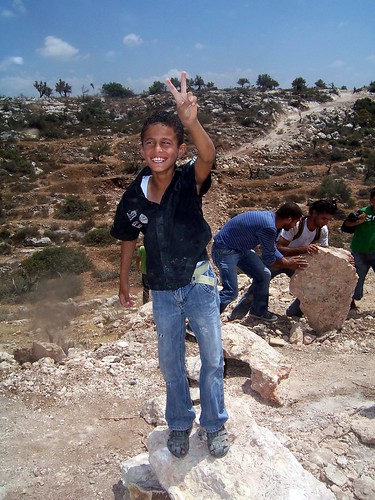
It’s what I’ll be listening to tonight thinking about the death of the ten-year-old Palestinian boy pictured above, who was shot in the head and killed by Israeli forces on Tuesday in the village of Ni’lin.

Lots of innocents die everyday in the Middle East and around the world, but this death holds special significance for me because the child was known to my friend and colleague Willow Heske (she posted this picture on her blog), who is working in Palestine for the summer. It also resonates because this child was shot during demonstrations against the “security wall” (more appropriately called the “apartheid wall”) being built through his village. The wall is a violation of human rights and international law, an attempt to ghettoize a people based on ethnicity and a harbinger of bad times. We should all be concerned about it, especially we Americans, because our tax dollars are indirectly financing it.

I don’t like hyperbole for these kind of matters — the tragedy speaks for itself. I just want to bring attention to this boy’s unnecessary death.

Heart of Solitude, One Year Later

It’s been a year since two friends and I crossed the Sierra Nevada through its most remote heart. For me, it was a spiritual experience, extremely difficult — the most challenging climb/hike I’ve ever done — and a reference point for all things afterwards.

I’ve been thinking about it a lot because I have been so out of touch with nature since then, and decided to post a few pics from that time. (My brief encounter with nature in Batroun, see previous post, made me realize that.)

I am too selfish to write the place names — I don’t want this to be searchable and then draw a bunch of people to these amazing places. Some spots are secret and sacred, and should only be available to people who study topo maps for hours and dream about the obscure swaths of peaks, canyons and lakes where no trails lead.

Your eyes follow the lines, and a landscape opens up in your head. The unnamed lakes with their high elevations printed on them, the creeks in canyons so narrow all the contours touch, the glaciers that cling to northeastern cliffs on the highest peaks are flat and dry on the unbeautiful paper, but your imagination runs wild. Then, when you finally see the places that inspired these maps, there is no way to exaggerate how beautiful this hidden land is. The feeling of crossing over mountains and valleys with only your food, maps and shelter — and no guide or path — is the closest thing I’ve felt to flying like a bird. Pure freedom.

I won’t name the places, but I will give a few clues: Enchanted Gorge, 10 days of hiking and an east-west traverse of the Sierra Nevada, completely off trail. And I will say that we once went three days in California without seeing another person, which is an accomplishment. Enjoy.

Peering into the Gorge.
Everything was silent as we passed between two peaks named after mythic monsters.

Mouth of the Enchanted
(and we look like a party of 1860s surveyors)

On top of the world, somewhere on the western ridges.
We had nearly completed our crossing.

Dimmy’s final resting place at 10,500 feet, where he lay down to sleep and turned into a stone (inside joke).

Summertime Vibes Batroun Beach Party


This was the scene from an all-night capoeira fundraiser Sobrevivientes threw this weekend. It was a success on many levels and a great introduction to the beauty of Lebanon’s beaches. I will post a clip to give an idea of the vibe, but it takes too long in the net cafe… later.

Paintballin’, Blowjobs and Hizbullah

OK, so if that title doesn’t boost my page hits, I don’t know what will.

It comes from a short service taxi ride I took the other day (in service taxis, you pay a reduced fee and then the driver takes other passengers along the way).

Two boys, about 19 or 20, are sitting in the back seat when I hop into the cab near my apartment in Hamra. From their nearly perfect American English peppered with a few Arabic bas, ballah and khalas, I guessed they were students at the American University of Beirut.

They are having the sort of conversation I used to hear among boys and girls on the back of the 24 bus in San Francisco on the way home from school – who did what sexually, how far they went, the scandalous context. Voice volume is typically elevated in a sort of exhibitionism: the conversation is as much for the other passengers as it is for the kids.

In San Francisco, these conversations are lurid, and at the same time painful. One has the sense that such working-class kids – often around 16 years old – want to tell the world their activities to convince themselves of the gravity of lives too often laced with suffering. A sort of public transportation therapy.

Back in the service taxi, the kids seem to be approaching similar topics from a different angle – one less crude but more annoying.

“Oh man, so she didn’t even give you a blowjob?” says AUB Boy 1.

AUB2: “No, man.” He pauses as a girl crosses the street. “Oh, I think I know that girl. OK, I definitely know her. I can’t forget that ass. That girl has a nice ass.”

AUB2 says this as if he is trying to convince himself that he really thinks this, and maybe to show off to his friend, and to me (foreigner) that he is capable of such comments. It lacks the rawness of the SF conversations, and the undertone. It is not mixed in with other talk about who got beat up, who has a gun and the excesses of intoxication, as it would be in SF.

These kids are privileged AUB students, even if they do live in war-torn Lebanon, I think.

“Hey man, you wanna go paintballin’ sometime?” says AUB1.

“Sure man, definitely.”

*****

If the middle-aged taxi driver with Islamic prayer beads hanging from the rearview mirror understood any English (I do not think he does), he might recognize the reference to paintballin’. He is Shia, I soon learn, and a staunch supporter of Hizbullah, so there’s a decent chance he lives in Beirut’s southern suburbs, where, incidentally, the local paintballin’ facility is also located.

As we drop off the kids in front of AUB, the conversation between me and the taxi driver turns to politics. (It’s inevitable; I should never have told him I am an American. But lying – even little lies – is almost as exhausting as these political conversations.)

I learn that the taxi driver holds Sayyid Hassan Nasrallah in very high esteem. “He is the only honest politician in the world,” he says, or something to this effect. I am still getting used to the Lebanese accent, and my comprehension veers from total to foggy. He says America should leave Lebanon to its own affairs, he complains about Rice and Bush.

I agree, but I draw the line when he says Barack Obama is a liar. The driver is mad because, he says, Obama kicked out two veiled women from a campaign event. (A story based in some fact, apparently.)

He drops me off in a cheery mood – I always seem to be able to effect this with taxi drivers – and I walk by the bars of Gemayze to work.

*****

Woah, I think. These are the paradoxes of Lebanon. What will be the “conversation” that occurs between the Blowjob Bros and this taxi driver’s children one day?

Maybe what they want is not so different. Maybe, because of my vantage point, I have seen the same thing from different angles. I hope so.

Mama Syria: Some Anecdotes from Homs

Last Friday evening I leave late with my friend Ghaith for Homs, his home city, two hours north of Damascus. He is a little disappointed – he would have liked to leave earlier, because he wanted to show me the countryside and a village. But I had meetings with other friends all day, and couldn’t get away.

Ghaith is like all my Syrian friends in that he is desirous of my time and utterly generous at the same moment, demanding a lot from me and giving me even more. There is no reasonable request to which he would say no. He and others try to give me money, insist I eat from their refrigerators when they had little, use their cell phones, act as if they were personally insulted when I tell them how a cab driver overcharged me.

Ghaith complains about the condition of Christians in the Arab world. He also clearly loves Arab cultures. He is enthralled with old poetry and romantic songs. Arabic is his mother tongue, and the only language he speaks fluently.

We take turns testing each other’s translation skills by listening to songs on my iPod on the bus to Homs. I play him “Imagine,” by John Lennon, and he likes it a lot, though he seems not too sure about the line “imagine no religion.”

We get into Homs by 10:30, in time to eat dinner with Ghaith’s family. They are barbecuing on the tiny balcony of their small apartment in a nondescript block of housing somewhere in the sleepy city.

The breeze is blowing, a fact about which Homsis seem proud.

“Fi buroud bi Homs, ma?” Ghaith says with a smile. There’s coolness in Homs, no? (Something those big-city Damascenes can only dream about: Homs is on a high, cool plain.)

I sit on the couch and watch Turkish soaps dubbed into easy Arabic with his sister. Every so often Ghaith taps on the glass sliding doors and insists that I eat a succulent morsel from the kebabs.

We eat dinner with glasses of araq on the rocks. Ghaith’s father, a craggy man with a prominent pot belly, gnarled strong limbs and a bottlebrush mustache, tries to crack jokes with me in broken English, which makes the Arabic in between that much harder to understand.

Ghaith’s mother, a stout, dark-haired, doting woman, keeps emerging with more plates of skewered meat, onion and tomatoes. Slight beads of perspiration form on her brow.

Afterward, while the women do all the cleaning up (I try to insist on helping, an idea greeted as ridiculous for the double reason of me being a male and a guest), the father regales me with tales of his time in the United States, where he spent several multi-year periods.

His face is a grizzled, sun-burnt crimson above his A-shirt as he tells of the time robbers put a gun to his friend’s head in an L.A. convenience store where he was working and he had to get the “Mexican woman” next door to call the police. He has been to Las Vegas “many times.” One time the police pulled him over and he told them he was French, and they let him go. He switches to English to mimic, rather unconvincingly, the voice of the woman who “wanted to marry” him when he worked at “the store” in L.A. He calls black people “abeed,” which I hate. (It means “slaves” in Arabic and older people often use it.)

“You can’t say that, Dad,” Ghaith says, knowing I am offended.

The father says America is beautiful, wallahi al-azeem. He can’t go back now because he overstayed his last visa.

Ghaith’s father’s physique and presence would seem to be the result of a peculiar combination of habits. He smokes two packs a day and generally does not eat vegetables if they are not accompanied by meat. He also rides his bicycle 10 kilometers a day to and from work.

Then, in the dialect of the Bedouin, he can recite beautiful poems called Baghdadis. His family is from eastern Homs governorate, on the edge of the desert. When he was a child – and the family had already moved to the city of Homs – bards would sing these songs, and he would memorize them. The poems have several lines ending in a word that sounds the same but has a different meaning in each case. They deliver an emotional punch even when I have no idea what they are about.

I imagine the father as a small Christian boy at the feet of a roaming bard in a dimly lit village, hanging on every word, as his whole family and I are doing now. No one besides the mother understands the Bedouin dialect in which the father sings the poems, and he must explain them.

The foreign words bring to mind the vastness of a dark desert, a place where the stars are the brightest thing at night, and life’s longing is undisguised. The songs are about lost love.

Back in his room in Damascus, Ghaith plays for me Bedouin songs that he has saved on his mobile phone.

“You understand that one?” he grins. “That one’s impossible.

“He’s saying that he is in love with a girl and wanted to marry her. She agreed, with the condition that he break his relationship with his mother.”

The singer wails and repeats the line.

“He’s saying that when your mother sees your silhouette in the desert from afar, she cries from camp to greet you. She doesn’t care about how you look or what you have done.

“But when the girl sees your silhouette in the desert, she tries to reckon your appearance before she rises to greet you.

“The girl is beautiful, she has the choice of many men in the world; for your mother, there is only you.”

What does the suitor do in the end?

“Ha, he stays with his mother,” Ghaith says. He clicks off his phone and reaches for hot water, to fill our glasses of yerba mate.
Syria Changes

Back in Beirut after a week in Syria, I already feel far away from Cham, which is a city that raised me, in a way.

Being in Damascus was like visiting the city of one’s childhood in a dream. Everything looks normal at first, but then there are bizarre differences from real life — exaggerations, unmarked absences — that creep up on you until you realize it is not really the same place at all.

The changes stem from the fact that Syria is trying to open up economically and the socialist sheen is disappearing. In that sense, its society is fading into a plain old dichotomy between rich elites and poor people. People say that the middle class is dwindling.

A snapshot: Damascus has new, green public buses and people have bought new cars by the thousands — Hyundai, Skoda, Peugot, etc. — so it no longer has a Cuba-of-the-Middle-East feel. The number of restaurants and hotels in the old city appears to have about doubled. The government has torn up parts of the old city for refurbishment. There are more beggars on the street — there were once hardly any. Youtube and Facebook are officially blocked, and many of the internet cafes appear to have shuttered, though I couldn’t say why. Foreign companies like KFC are more prominent, and there is a big, American-style mall in Kaffar Sousseh.

Average Syrians aren’t thrilled with the economic changes. They say the cost of living has shot up, and salaries haven’t.

“There are only two ways to live now,” one upper-middle-class Syrian told me, smiling. “You can steal… or, you can die.”

The friend I stayed with in a crumbling, mildewed, shared room in a poorer Christian neighborhood is experiencing the economic climate more directly. With a college degree, he has a “good-paying” job at a bank that is working him hard. The pay is about $500 a month. Enough to get by, and have the occasional indulgence at a cafe. But hardly enough to build a future.

Of course, I love Syria dearly, and I think it has been much maligned — and subjected to ridiculous measures, like the prohibition by the United States of shopping at the airport’s duty-free — while the greater misdeeds of other countries (ahem) go completely ignored. I also understand the need for economic reforms. I hope for a bigger Syrian role in international affairs, for its prosperity as a country, and deeper acknowledgment of the burdens it has had to bear as a result of the war in Iraq and the generosity it has shown to refugees.

I just don’t think I’m hearing much support from among Syrians for the direction that’s been chosen.

In any case, I won’t forget the day I came into town: flying down out of the mountains on a Sunday morning in the July sun, the city sparkling, green and peaceful below, joy rushing inside me as I recited the neighborhoods through which my taxi passed, just to feel their names on my tongue. A brief homecoming.

For next time, a few comments on a more personal note…


Bahia Axe in Beirut and Damascus

Just a quick update (many more to come):

I am enjoying the heck out of myself in Damascus seeing old friends, although there does not seem to be enough time to see everyone. I will feel terrible that I was not able to visit every person I have a connection with while here. But it’s just impossible.

A great highlight of the last few weeks in Beirut and Damascus has been the existence of capoeira in both. There are good players here and bona fide capoeristas with years and years of experience.

That’s meant an instant community for me, no hiatus in training, and something anchoring my life in places both old and new. It’s what ties all the places I visit together.

Axe!

Dubai to Beirut

I just got into Beirut and I’m really happy to be here. It helps that I spent all of my last day in Dubai (Sunday) in traffic and scouring megamalls in 113 degree heat for “Canadian cigarettes,” which a guy here in Lebanon had asked me to try and pick up. No luck.

The Palestinian-Syrian guys i was hanging out with are living large in Dubai, notwithstanding their residence in the neighborhood they refer to as “Karachi”, a rundown Pakistani area where my friends sleep three to a room. Rent is astronomically expensive in Dubai, but goods and services are cheap. They have enough money to go out and watch Euro Cup games, and I have to say that despite the fact I find Dubai totally distasteful, I am happy to see these guys finally relaxed. They have lived in a refugee camp with something of a refugee camp mentality for their whole lives, and it was nice to see them puffing sheeshas at a seaside Lebanese restaurant called Shu, watching the football game and feeling carefree. These friends were unbelievably hospitable to me the whole time and I barely had to spend any money.

But other than that… whew, Dubai is a crazy place. And not really a pleasant one. (The fact that I got strip searched on arrival for no reason at all does not, of course, help its image!)

The emirate is a hectic menagerie of half-inhabited skyscrapers barely visible in a sky choked with desert sand and Gulf humidity. It is definitely among the most bizarre places I have ever seen. Pakistani and Filipino workers — along with everyone else — are walking around in the heat with a kind of dazed look on their faces. To call it soulless would not be an exaggeration. All the communities there appear haphazard, temporary and recent. It’s a money pot, but not much more.

So it is great to be back in Beirut. It feels like a homecoming. Everything is familiar — the big trees, the humid but not suffocating Mediterranean air, the bars with their neon signs in narrow streets, with the shadow of mountains looming behind them. At moments, it feels like it was only yesterday I was last here (it was October 2006). At others, I simply feel it has been far too long. I’m anxious to experience this region with Beirut as a door to understanding it rather than Damascus.

Um Pouquinho de Dendê


Watching the United States-Barbados qualifying match on Sunday, I was struck by how the American team — even as their technical skills improve — continue to play like cardboard cut-outs of soccer players. The friend I watched the game with pointed out that U.S. star Landon Donovan personifies this style of play.

Now, I’m about to be a real Long Gone Daddy — off to Lebanon for two months for a journalism internship. When I asked my friend what I should look for out of my internship, he said:

“Just don’t play it like Landon Donovan — textbook perfect. Give it more than that.”

That’s no disrespect to Landon Donovan. He’s a far better footballer than I could ever have hoped to be.

What my friend really meant is summed up in a capoeira song we sing: Eu vim aqui buscar um pouquinho de dendê: I came here to pick up a little bit of dendê, which is palm oil.

It means, put a little oil in your game. Make it smooth. Do the unexpected and play with style.

So as I head off today, that’s what I am keeping in mind!

Peace, America. I’ll see you on the flip side of summer.