Valley Fever: A poetic interpretation

IMG_0634

Valley Fever is a nasty, sometimes incurable and even deadly fungal infection that afflicts hundreds of thousands of people , as I learned in an article in this week’s New Yorker, by Dana Goodyear.  It is particularly prevalent in the American West, thrives in dry, dusty environments, and takes its name from the Central Valley of California, where it first gained notoriety and continues to be a major problem. Now I finally understand all the lyrics to Bakersfieldian Merle Haggard’s “Tulare Dust.”

Reading Goodyear’s piece, and in light of what I know of the history of this part of the country, I can’t help but feeling like Valley Fever is a kind of retribution for our torture of a rich land, a kind of fuku a la Junot Diaz’s The Brief Wondrous Life of Oscar Wao. Or a Godzilla — a sleeping monster awakened by the hubris of man.

Of course, if you pressed me on it at all, I’d back down on this story right away. The facts are more complex, it’s unproveable, it’s a mystic theory at best if not downright superstitious, and it doesn’t do much for the thousands suffering debilitating symptoms from cocci infection to ruminate from afar on the big historical arc of Valley Fever’s emergence.

Still, if you will indulge me, here is my poetic recipe for how to summon up Valley Fever:

1. Arrive to a rich land unknown to your people. Chase its denizens into the hills and pay thugs to kill those who evade capture.

2. In the valley (now mostly vacant from humans) that John Muir described as “like a lake of pure sunshine, forty or fifty miles wide, five hundred miles long, one rich furred garden of yellow Compositae,” decide you will make a farming empire. To this end, drain the biggest fresh water lake west of the Mississippi.  Tulare Lake was the terminus of the southernmost salmon run in the United States, a vast wetland of tule marshes and grizzly bears that served as a stopover for hundreds of thousands of migrating birds. By 1899, after about five decades of intensive diversion for agriculture, it was gone.

3. Don’t stop there. Dam every tributary to keep the damn thing dry.

4. Divvy up the vast fertile valley bottom — one of the most productive areas in the United States — among a handful of rich mega-farmers who use their sway to get government-subsidized water rights. These farmers’ monopoly on water and land will keep the waves of migrant laborers who come from Oklahoma, Texas, the middle South, and later Mexico and Central America, indigent and landless.

5. But then the soil becomes exhausted, the people desperate. Drought grips the land. The inland sea is now a desert. The earth  has become saline.  Dust storms punish the grim towns.

6. As they become untenable, convert the cotton farms and orchards to prison yards, sewage dumps from distant cities, and bleak tract developments promising a simulacrum of suburban paradise, tidy faux-bucolic neighborhoods that end abruptly at empty fields and cement walls on the edges of freeways.

7. Reap the whirlwind, quite literally. Unleashed in the dust at the bottom of the lake, stirred up by plowing, drought, and construction, are deadly fungal spores that infiltrate every nook and cranny, riding high on billowing clouds of Tulare dust.

A compelling moral narrative? I think so.

Here’s the extended reading list that brought me to this version of events:

The King of California: J.G. Boswell and the Making of A Secret American Empire, by Mark Arax.

Cadillac Desert: The American West Its Disappearing Waterby Marc Reisner.

Ishi Rediscovered by Robert Burrill.

Indian Summer: Traditional Life Among the Choinunme Indians of California’s San Joaquin Valley, by Thomas Jefferson Mayfield.

“Showdown at Tejon Ranch,” by Edward Humes in California Lawyer Magazine, June 2007.

The Grapes of Wrath by John Steinbeck.

Help me complete my list of Central California history reading in the comments, please.

SF’s techie communes: hippies minus the politics?

An SFGate.com article from a couple of months ago, about communal living among techies in San Francisco, caught my eye recently. Have a look.

A quick reaction that is a bit too long for a tweet: I have to say I like the way these techies think about living spaces, and I like the echoes of San Francisco values in the arrangements they are pursuing. But I find it interesting that just about all their reasons for doing this — at least the quoted ones — involve them being better entrepreneurs, more “successful,” and more efficient. Political consciousness doesn’t seem to come into it, especially in any kind of more largely critical way about the economic and social status quo of America. I’m sure they all have perfectly liberal impulses on an issue-by-issue basis, but the political revolutionary impulse is missing. Technology is the ideology.

Which makes them very different from hippies indeed.

John Steinbeck’s lessons for a gentrifying San Francisco

Sidewalk graffiti on San Bruno Avenue, San Francisco. "SFC" stands for "Sucka Free City."

Sidewalk graffiti on San Bruno Avenue, San Francisco. “SFC” stands for “Sucka Free City.”

Writing about San Francisco’s changing neighborhoods — a gentrification crisis according to some, a renaissance according to others — has  become quite the fashion in recent months and weeks. I can only assume many of these journalists were inspired by my devastating analysis of census data earlier this month.

The subject has been especially popular of late, but change in San Francisco is nothing new. Even change from the tech boom(s), while reaching a fever pitch in the last couple of years, has been going on since the 1990s. And many of us who feel so pained by the loss and/or change of the City’s vibrant communities would do well to remember the variety of incarnations it has been through in the last century and a half, right up until recent decades. When my parents moved to Bernal Heights in the late 1970s, my dad remembers going to a community meeting at St. Kevin’s church on Cortland, in which some participants said they were uncomfortable that many of their new neighbors were gay. At the time, Bernal was a very ethnically mixed neighborhood, with an especially large number of Latinos. My dad reminded people at the meeting of the backlash many Latinos faced a generation before when they moved into the largely Irish Mission. The meeting took a different course at that point, he says.

Change is the only constant in San Francisco, to use an unavoidable cliché, and the City has distinguished itself by its ability to embrace it, while maintaining some sense of continuity.

Sara Brody has some interesting thoughts on this over at The Bold Italic, though I take small issue with the headline, “Don’t Let Gentrification Push You Out of SF,” since in many cases it is only the most privileged vestiges of San Francisco’s old communities that actually have a choice about “letting” gentrification push them out. Most who have moved, at least the renters, left not as a matter of taste because they couldn’t afford it any more. Involuntary movement is a tragedy, always.

That being said, though, Brody raises some excellent points, the most important one for me being the uselessness of bitterness. Bitterness about change is part of an essential paradox of San Francisco, a city more liberal and welcoming than almost any, but with a deep and almost conservative devotion to its history. This paradox is almost never resolved. I’ve met descendants of old-time Irish San Franciscans who moved out of the City in the 1960s and still lament how it will never be the same. On the other hand, there are others who stayed if they could, remained involved in the new communities, and maybe even started calling Eureka Valley the Castro. (For a good account of these diverging reactions, read The Mayor of Castro Street)

So, to get to the (damn) point of this post: I just read John Steinbeck’s Travels with Charley, the account of a 1960 cross-country trip the native northern Californian, then resident in New York, took around America with his dog. A significant section deals with his reflections on the Bay, noting what was still there, and reminiscing about what wasn’t any longer. Time and again, I found wisdom in Steinbeck’s observations that is deeply relevant — even enlightening — for considering our current times in San Francisco. He is a gentle curmudgeon, one who honors the past while accepting the inevitability of change, especially in our fast-paced times. I think he provides a model for how to relate to the changes in the City. Here are a few excerpts, mostly from his time in Northern California.

On change in mid-century America:

Even while I protest the assembly-line production of our food, our songs, our language, and eventually our souls, I know that it was a rare home that baked good bread in the old days. Mother’s cooking was with rare exceptions poor, the good unpasteurized milk touched only by flies and bits of manure crawled with bacteria, the healthy old-time life was riddled with aches, sudden death from unknown causes, and that sweet local speech I mourn was the child of illiteracy and ignorance. It is the nature of a man as he grows older, a small bridge in time, to protest against change, particularly change for the better. But it is true that we have exchanged corpulence for starvation, and either one will kill us. The lines of change are down. We, or at least I, can have no conception of human life and human thought in a hundred years or fifty years. Perhaps my greatest wisdom is the knowledge that I do not know. The sad ones are those who waste their energy in trying to hold it back, for they can only feel bitterness in loss and no joy in gain.

And on returning to northern California:

I find it difficult to write about my native place, northern California. It should be the easiest, because I knew that strip angled against the Pacific better than any place in the world. But I find it not one thing but many–one printed over another until the whole thing blurs. What it is is warped with memory of what it was and that with what happened there to me, the whole bundle wracked until objectiveness is nigh impossible. This four-lane concrete highway slashed with speeding cars I remember as a narrow twisting mountain road where the wood teams moved, drawn by steady mules. They signaled their coming with the high, sweet jangle of hame bells. This was a little little town, a general store under a tree and a blacksmith shop and a bench in front on which to sit and listen to the clang of hammer on anvil. Now little houses, each one like the next, particularly since they try to be different, spread for a mile in all directions. That was a woody hill with live oaks dark green against the parched grass where the coyotes sang on moonlit nights. The top is shaved off and a television relay station lunges at the sky and feeds a nervous picture to thousands of tiny houses clustered like aphids beside the roads.

And isn’t this the typical complaint? I have never resisted change, even when it has been called progress, and yet I felt resentment toward the strangers swamping what I thought of as my country with noise and clutter and the inevitable rings of junk. And of course these new people will resent newer people. I remember how when I was a child we responded to the natural dislike of the stranger. We who were born here and our parents also felt a strange superiority over newcomers, barbarians, forestieri, and they, the foreigners, resented us…. And we were an outrage to the Spanish-Mexicans and they in their turn on the Indians. Could that be why the sequoias make folks nervous? Those natives were grown trees when a political execution took place on Golgotha. They were well toward middle age when Caesar destroyed the Roman republic in the process of saving it. To the sequoias everyone is a stranger, a barbarian.

And on returning to San Francisco:

When I was a child growing up in Salinas we called San Francisco “the City.” Of course it was the only city we knew, but I still think of it as the City, and so does everyone else who has ever associated with it. A strange and exclusive word is “city.” Besides San Francsico, only small sections of London and Rome stay in the mind as the City. New Yorkers say they are going to town. Paris has no title but Paris. Mexico City is the Capital.

Once I knew the City very well, spent my attic days there, while others were being a lost generation in Paris. I fledged in San Francisco, climbed its hills, slept in its parks, worked on its docks, marched and shouted in its revolts. In a way I felt I owned the City as much as it owned me.

San Francisco put on a show for me. I saw her across the bay from the great road that bypasses Sausalito and enters the Golden Gate Bridge. The afternoon sun painted her white and gold–rising on her hills like a noble city in a happy dream. A city on hills has it over flat-land places. New York makes its own hills with craning buildings, but this gold and white acropolis rising wave on wave against the blue of the Pacific sky was a stunning thing, a painted thing like a picture of a medieval Italian city which can never have existed. I stopped in a parking place to look at her and the necklace bridge over the entrance from the sea that led to her. Over the green higher hills to the south, the evening fog rolled like herds of sheep coming to cote in the golden city. I’ve never seen her more lovely. When I was a child and we were going to the City, I couldn’t sleep for several nights before, out of bursting excitement. She leaves a mark.

And my favorite of all, as we wrap our heads around a city that will be changing, no matter what:

It remained the City I remembered, so confident of its greatness that it can afford to be kind. It had been kind to me in the days of my poverty and it did not resent my temporary solvency.

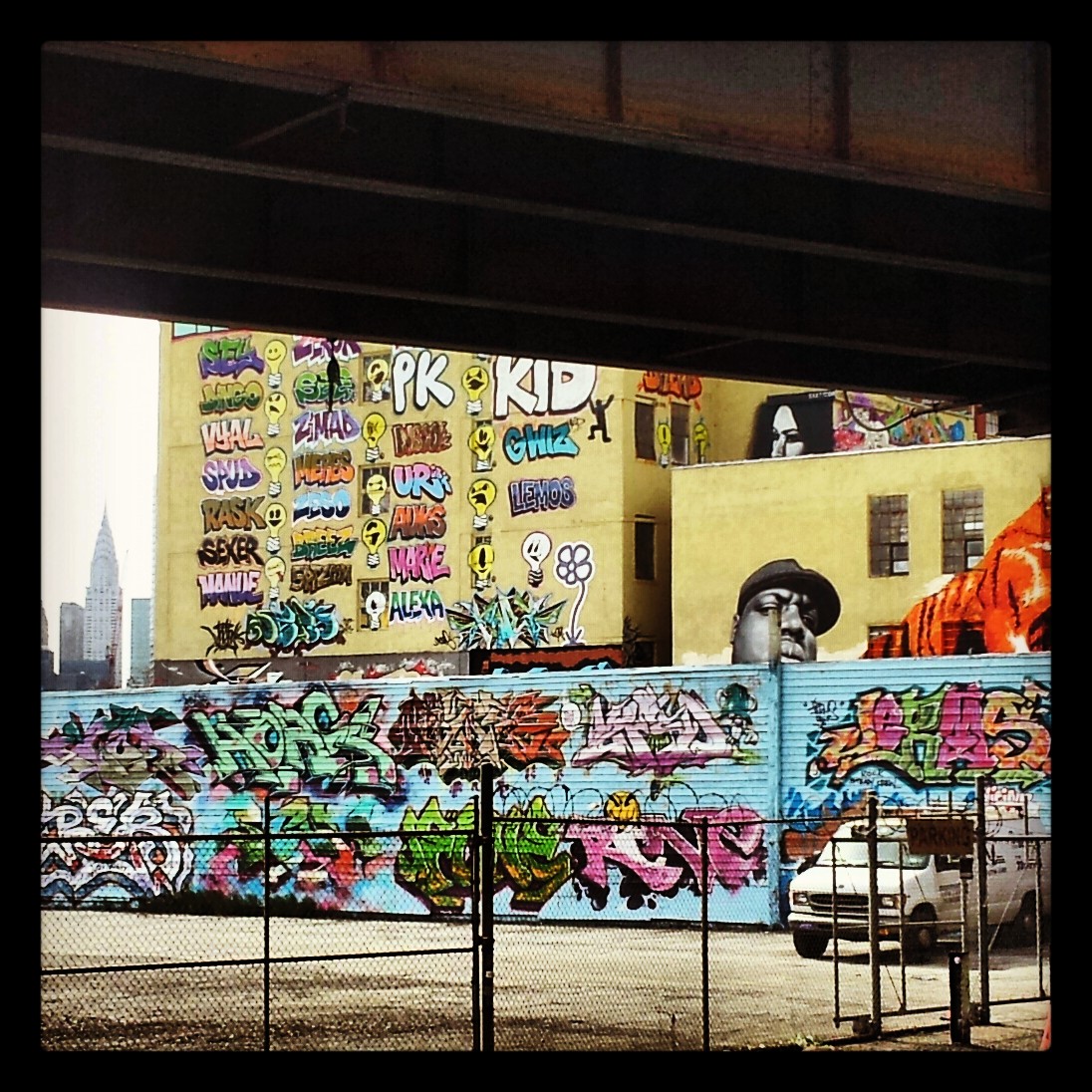
5 Pointz is long gone

A sad scene greeted New Yorkers this morning. This …

5 Pointz Biggie

5 Pointz Biggie

… had turned into this (photo from the LICPost):

Yes indeed, after a drawn-out battle that seemed pulled from the pages of a break dance movie script (except without the happy ending), world famous Long Island City graffiti installation 5 Pointz is long gone. The owner of the building, who had reportedly done nothing with it for 20 years besides allowing the artists to squat there (so I was told during a tour), is tearing it down to make way for these glorious luxury condominiums. (Photo from Atlantic Cities.)

I only found out about the place a couple of years ago, and it has surprised and delighted each of my NYC guests ever since. It was a true urban gem. I don’t know enough about the legality of the issue to comment much on that dimension of the art’s destruction, but one thing is for sure: the loss of this site is pretty much a major cultural tragedy for New York City. I sort of hope that if there really is 10,000 square feet of blank wall dedicated to aerosol artists’ use in the new development, as has been proposed, it remains mutely white in protest.

Here’s a brief slide show from my first visit to 5 Pointz.

This slideshow requires JavaScript.

Some troubling demographic facts about San Francisco

20130626_140121

From the beautiful murals that crowd the alleys of the Mission, to the talk show you just listened to on your way home on KPFA, to the jealousy with which it guards its counterculture iconography, San Francisco has a lot of emotional investment in a particular image of the city: caring, diverse, pro-worker, progressive, conscious, sustainable, committed to equality. (Trust me, I’ve spent most of my life in the midst of it.)

As I’ve frequently written on this blog, it feels like the city (the City, if you’re from the 415) is drifting away from these ideals—in the facts on the ground if not in the minds of its residents. So I decided to poke around on the Census website and see what the statistics could tell me. What I discovered was quite stunning: the image of a city behind the curve, with some near-criminal inequalities.

In no particular order, here are the first rounds of what I found. There’s lots of additional data out there, so I hope to expand on this in future posts. Unless otherwise linked, these numbers and images are from the (amazing!) Web site of the United States Census.


San Franciscans are richer than Manhattanites

The median household income in SF is $72,947 to Manhattan’s $67,204, about 8.5 percent higher.


San Francisco may be more unequal than Nigeria

San Francisco’s Gini coefficient (the most common measure of income inequality) was about .52 in 2012 – which, according to World Bank figures, is higher than Nigeria. Here, the city does less poorly compared to others, which I don’t find very comforting. Oakland is about the same, at .52, and Berkeley clocks in at .54. Los Angeles is nearly the same as San Francisco. New York is a bit higher, at .54. Of course, America’s Gini is the highest of the advanced economies, anyway (.476, according to the Census, though different data sources give very different numbers). What is particularly striking to me is income inequality in San Francisco mapped against race, which I describe later in this post.


Fewer kids than other big cities

Persons under 18 years old are 13.5 percent of the population in San Francisco. That compares to notoriously kid-free Manhattan with 14.9 percent. The figure is 15.4 percent in Seattle; 21.3 percent in Oakland; 21.4 percent in San Diego; 21.6 percent in all five boroughs of New York City; 23.1 percent in LA and Chicago; 25.9 percent in Houston.


Not so diverse as we think

“Discover the variety of sites, shops, and restaurants that reflect the City’s great ethnic and cultural diversity.” Thus the Web site of the city of San Francisco greets the city’s visitors. Many San Franciscans do cherish ethnic diversity as a principle, and think of their city as a flag-bearer for it. While that love of diversity is wonderful, in 2013 San Francisco is not looking like much of a flag-bearer, compared to other major cities—regionally and across the country.

More white people

San Francisco is a white-plurality city, with non-Hispanic whites composing 41.7 percent of the population in 2012. (Hereafter, I’ll just use “white” rather than “non-Hispanic white”.) Few would be surprised to hear that this is higher than, say, Oakland (which is 25.9 percent white). But San Francisco is also whiter than California as a whole, at 39.4 percent. San Francisco is less white than Manhattan (47.6 percent), but New York state is far whiter than California, and when we look at all five boroughs of New York, the white population comes down to just 33.3 percent of the total.

And it really gets interesting when you put it in historical perspective: California was 57.2 percent white in 1990[2]; San Francisco 46.6 percent. In other words, since 1990, California as a state has become less white 3.6 times faster than the city.


Still a strong Asian population

San Francisco continues to have a very large Asian population, at 34.2 percent of the total (up from 29.1 percent in 1990). Still, this increase has been slower than the increase in the proportion of Asians in California generally, from 9.6 percent in 1990 to 13.9 percent in 2012. I am sure this observation would be enriched with some data on incomes, which I hope to add in a future post.


Fewer Latinos

The percentage of San Francisco that is Latino (or in the terminology of the Census, Hispanic of any race) is, at 15.1 percent, little changed or even a slight increase in the last few decades. But the city is far less Latino as compared to the rest of the state than it was in 1990. In 1990, California was 25.8 percent Latino; today it is 37.6 percent. In context, San Francisco has become less Latino as compared to the state in general.


Dwindling number of African Americans

The shrinking of the city’s African American community in the last two decades is one of the most remarkable ethnic shifts in the city. African Americans are just 6.1 percent of San Francisco’s population of 825,863[3] – a 44 percent proportional decrease from 1990, and a 50 percent proportional decrease from 1980[4].

But this is only part of the story when it comes to the troubling status of black San Franciscans: on the whole, they are far poorer than other groups in the city. The median income of a black household, $30,840, is just 35 percent of the median non-Hispanic white household, $89,140.[5]

The African American community in San Francisco is singularly left behind.

African Americans across the state and across the country also lag behind in median income, but not by anywhere near as much. The median income of black households in California is 63 percent of white; in America in general it is 62 percent of the white median.

The gap in San Francisco is also much larger than it is in other parts of the Bay Area.

In Alameda county the ratio of median black to median white income is 49 percent; in Contra Costa 57 percent; San Joaquin, 69 percent; San Mateo, 55 percent; Santa Clara, 59 percent; Solano, 74 percent; the Bay Area in general (the Census’s San Jose-San Francisco-Oakland, combined statistical area), 52 percent.

But in this comparison to Manhattan, at least, San Francisco can take some small, cold comfort: median black Manhattanites (18.4 percent of the population) make just 32 percent as much as median white Manhattanites. Throughout the five boroughs the ratio is 59 percent.

Let’s look at the income of San Francisco’s African Americans in another way, comparing it to other cities in the Bay Area. Darker green indicates a higher median black household income. (These are absolute levels, not proportions.) Starting clockwise from San Francisco, the cities are San Rafael, Vallejo, Richmond, Berkeley, Oakland, Hayward, and San Jose.

Bay Area black income

Now compare this to the median white income for these cities.

Bay Area white income

Clearly there is something different going on in each of these cities. But San Francisco really stands out in that it has a very high median white income and an extremely low median black income.

This will not be a surprise for anyone who has spent 20 minutes on Potrero Hill (which is divided roughly 50-50 between gaudily painted restored Victorians and vast rows of housing projects, and whose ethnic and racial make-up is similarly divided).


Some conclusions

Many of the aspects of the narratives that San Franciscans tell themselves about their city are flawed at best, and sometimes simply false. The image of San Francisco as a paragon of diversity is no longer true. It is not that San Francisco is homogenous—not by any means—but rather that compared to many other major cities in the state and the country, it is wealthier and whiter.

This doesn’t mean that San Francisco is a racially intolerant city—far from it. I have no reason to think that in this case, income data would perfectly dovetail with biases and opportunity. (Indeed, I have plenty of personal anecdotes to the contrary.)

Most of these inequalities are probably related to the lack of a useful affordable housing plan, without explicit racial overtones (though San Francisco certainly has a history of that), and lack of regional coordination in urban planning.

And the economic barriers to living in San Francisco do not mean in and of themselves that it is a qualitatively bad place to live for poor people. Income is not the only measure of wellbeing. (Though when the median household income for a demographic slice of the population is $31,000, in a city where the average rent for a one-bedroom apartment is edging toward $3,000/mo, it is hard for me to see how qualitatively good this could be.)

Still, these statistics show that, when it comes to being progressive, talk is cheap. The numbers are out of whack with the rhetoric in San Francisco. Maybe it’s time to come to grips with the kind of city we really are: unequal with racial overtones, inaccessible to families, a follower rather than a leader in regional demographic trends of greater diversity.

Hm, maybe this could be related to the way we are seen elsewhere…

Russell Brand is a mediocre spokesman for some important ideas

RANT ALERT!

Of course I enjoyed watching this interview of Russell Brand, which Gawker says may spark a revolution.

Brand is right about a lot of things. He’s articulate and cutting and Paxman gets what he deserves. The questions aren’t very good, and Brand’s shtick is perfectly tuned to Paxman’s condescension. So it’s satisfying to see him practically jumping out of his chair and bringing the heat. And it’s satisfying to see him disrupt the staid and practiced drama of this kind of an interview.

But that being said, I’m really not that impressed. Brand is a celebrity calling for change in vague terms. I agree with many of his positions. Global and national inequality are huge issues. We are indeed destroying the environment at a horrifying pace. The political systems in the US and UK have deep, deep problems. Part of the solution involves looking inward. Good for Brand for pointing all this out, and using his celebrity to do so. But there are people working day and night to advance these same ideas in much more practical and specific ways. It might seem like they’re losing the battle, but can you imagine how much worse things would be if these people were not engaged? We might have a Koch brother as president. (Instead they’re just funding the opposition.)

None of this would be a big issue were it not for Brand’s exceptionally lazy and dangerous attitude about voting. There is absolutely no justification for this. It is a position I can only imagine someone holding if (a) they are so ensconced in privilege that they do not recognize how enormous their privilege is or (b) they are so at the margins of society that they’ve decided to check out completely. Brand is certainly the former, notwithstanding his working class background. Either way, not voting has zero validity as a political strategy. It’s true that our democratic systems have been disgustingly abused and rigged, but if you think, for example, that there is no difference between G.W. Bush and Obama, you must be very rich and comfortable indeed. Our system is not dysfunctional enough to boycott elections. If you think it is, you haven’t seen a dysfunctional system.

Oddly, voting is one of those things with a value that may be hard to appreciate until you don’t have it. Living in and visiting places where people are truly unable to vote or even express their opinions gives one a special appreciation for the privilege of these small but meaningful powers.  If you are in a country that has outright vote rigging, I can see the purpose of election boycotting. Brand is not in that position, and he’s lying to himself and everyone if he says so. It’s painful to hear him suggest that he is. People have laid down their lives again and again, in the United States and elsewhere, to obtain suffrage. It disrespects their legacies to shrug your shoulders and suggest that none of us should vote. Yeah, millionaire celebrity Russel Brand, of course you don’t think it matters. But don’t promote your ballot box passivity as a viable strategy for life. People in far more vulnerable positions than you will be the ones who suffer.

One thing I can’t abide is people who don’t acknowledge their privilege, or people who have privilege and refuse to try their best to use it for good. If you can vote in one of the most powerful countries in the world, do so! (But don’t stop there, either.)

*END RANT*
PS I will say that that was one of the greatest smirks I’ve ever seen at the beginning of the interview.

http://9gag.com/gag/azb103j?fb_comment_id=fbc_563750883690209_69482473_565574666841164#f34966ca28

Outdoor sports break: 60 miles north from NYC on the Old Put

As a Westerner venturing into the wilds of the East, it takes time to appreciate the region’s natural beauty. No crags here, no canyons, no shimmering plains. No sweeping views that some overripe Victorian would have called “both terrible and sublime!”

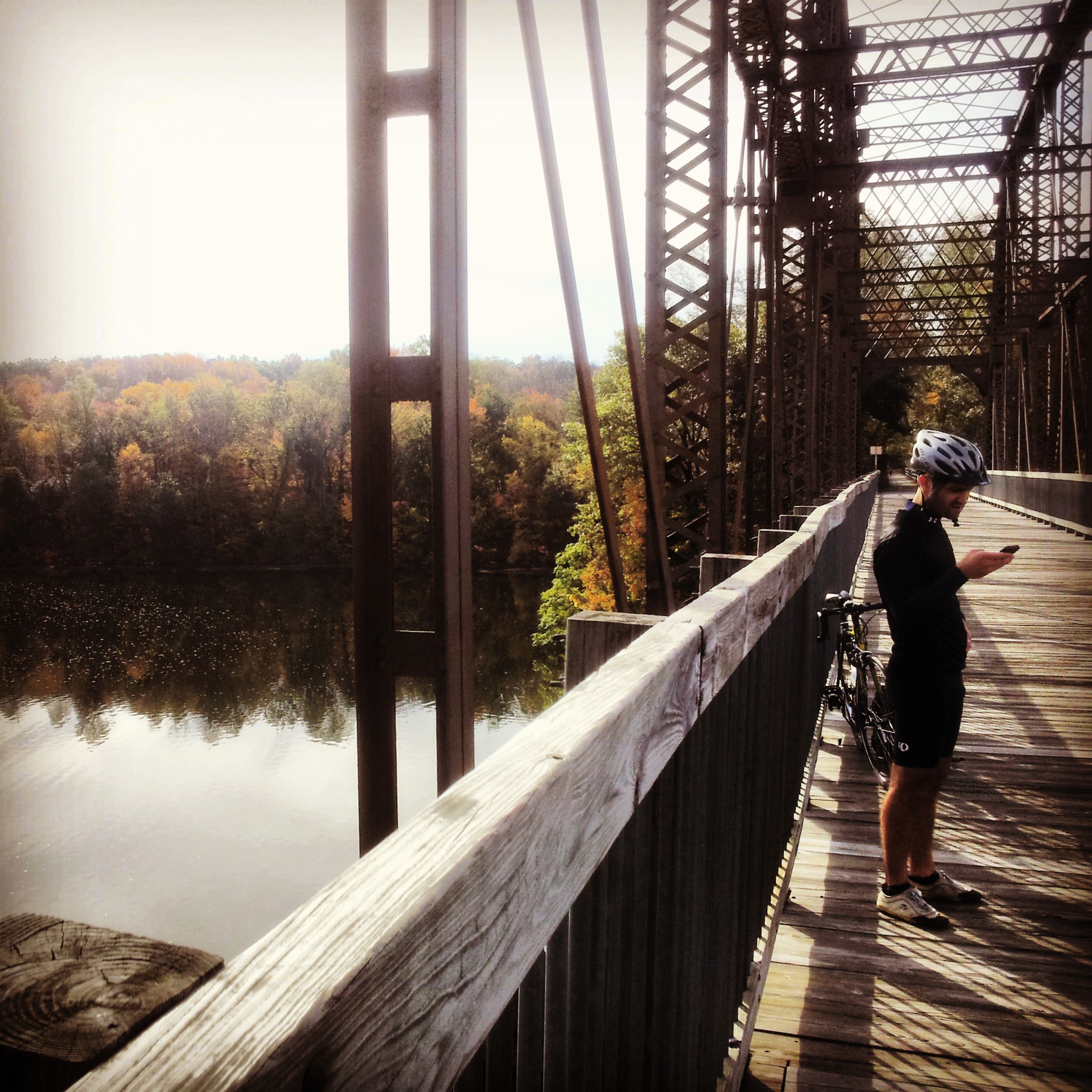
Today, I took the bike path that follows the Old Put some 45 miles north of the Bronx all the way to Brewster in Putnam County (nearly 60 miles north from my house, which I only point out so that you know what a beast on the bike I am).

Out north of Elmsford, you begin to learn about the spirit of the Eastern woods. It is hard to describe, because it lacks that Occidental splendor factor. Sure, it’s the peak of autumn, so the colors are great — but that hardly gets to the heart of the matter. Mile after  mile, it creeps on you. And when I returned and lay down exhausted in my bed, I closed my eyes and, without effort, saw myself projected through deep yellowing forests, the trees like wispy old fingers, a gray sky, a winding path strewn with rusty leaves, going on and on.

Below, crossing the bridge at the New Croton Reservoir.

Image

Image

Image

Nostalgia with purpose: Reflections on a New Yorker’s essay about leaving her city

Back when Rebecca Wolff was a kid, New York was so real, man, you guys don’t even know!

I liked eating this essay in Guernica, but then later I got a stomach ache.

As an expat native San Franciscan I identify a lot with her pining for a realer time — which is why I liked the essay’s flavor. But this writing exhibits what is in some ways the worst kind of it-once-was-realer nostalgia: the self-absorbed longing for the aesthetic of a harsh time, rather than for the lost possibilities that an earlier era held for a now-forgotten segment of the people. Through this privileged prism, being real is defined by running around snorting blow and making out with bouncers. The thing is, for most of the few people I know who were really in the grit of 70s-80s New York, I get a sense of being shell-shocked as much as anything.

Back then was other things, too. It was the taxi driver I spoke to who grew up in East Harlem and used to be scared to leave his house. It was feeling menaced by the evil lurking in the bushes when you jogged across a Queens park on your way home from 8th grade. It was AIDS, it was crack, it was the Son of Sam, it was a lot of people who didn’t make it to 2013 to talk about what a time of creativity it was — so I understand from conversations, and infer from my own San Francisco recollections.

It’s mostly true that all those people running around unironically ironically wearing “Obey” T-shirts in SoHo are Chumps, and probably I am too. But being cool is not really the point. The point is those bodies getting stepped over, which Wolff mentions but which don’t seem to elicit a more political perspective.

I appreciate Wolff’s essay, and it’s definitely worth a read. But the nostalgia to which I pledge allegiance is a different one: a longing for long-gone communities, uttering of the names of those who came before, who lived too fast or too close to the edge to tell their stories.

In the streets outside my house in San Francisco, members of these communities squared off, pulled weapons, revved the engines of rusted El Caminos, repped motorcycle clubs, covered wood-paneled station wagons and front yards with plastic figurines and schizophrenic sculptures, smoked glass pipes in stairwells, serenaded me to sleep with musical worship on Tuesdays, Fridays, and Sundays. It was not always an easy place, but in it was a promise of something greater. Saudades de vocês.

To acknowledge the raggedness of those times is not to give these cities’ current trends of chumpiness a pass. But in both New York and San Francisco, it is partly the solipsism of the reigning brand of nostalgia that has kept us from mounting a convincing counternarrative to those who would argue that the story of these cities has been, simply, progress.

In any case, have a read and let me know what you think.

So yes, it’s true. New York City used to be cool, and now it’s not. It’s not at all. It is boring and dismaying and stymied; everything potentially cool in it is overwhelmed and inflated and parodied and sold. You can’t even love the absurdity of it because it’s too painful and we cannot be allowed anymore to callously love, for their absurdity, systems that oppress and impoverish. New York is a giant sinking pile of crap compared to what it used to be. Literally sinking, now that the waters rise so much quicker, the winds blow so much harder than even scientists predicted. Lately I like to imagine that I will have the privilege of seeing in my lifetime real estate values in the city plunge wildly, freefall, as Climate Events force visitors to admit that they pay top-dollar to perch on coastal landfill.

In New York City these days I see loads and loads of formerly brilliant people—gender champions, visual whizzes, start-up ho’s, crackerjack dancers, actors, journalists, and chefs—who have stayed too long at the Fair, to use Joan’s wistful archaic turn of phrase, are baffled and internally conflicted as to why they can’t admit that New York sucks so hard. Why they can’t draw the proper conclusion: That if they are to work all the time in order to pay super-high rents that make it impossible for them to do their art, if they never have a chance to see the people they came here to see, who are also less brilliant now that they are muffled by the smog of wrongness that hangs over New York (thicker than the smog of smog that hangs over Los Angeles, another city that’s not even half as cool as everyone who’s moving there says it is), if they are living somewhere that is giving them less than they are giving to it, then they should leave. They should find somewhere to live, perhaps collectively, perhaps not individually, perhaps they should try to make sense of this whole living-somewhere thing in a way that doesn’t pretend, as New York City does, that we are all ruthless rock stars with amnesia and aphasia and lifetime amniotic sacs.

Image

Old San Francisco (Bernal Heights 2013)

A Dungeness Crab City

I complain a lot about the changes occurring in San Francisco, and I stick by those complaints. There is much being lost in the fading past of this “Dungeness crab city,” and certainly not all have benefited from the transformations. Reading this captivating article, however, I am reminded that there is something bigger happening as well. And along with being a time for a lot of greed and silliness and even mourning the losses, it is a moment of great energy and creativity, which seem too big to be stopped. Let’s make the most of it. If there’s any truth to the sentences below, maybe the energy can be harnessed for something bigger than profits… political consciousness, social engagement, new economic priorities… maybe…

In 1966, Hendrik Hertzberg, then a young Newsweek reporter in the Bay Area, wrote about San Francisco’s “new bohemianism”:

The hippies, much more numerous than the Beats ever were, accentuate the positive. . . . Like the Beats, they are dropouts from the conventional “status games,” but, unlike them, have created their own happy lifestyles to drop into. “In a way,” says Jerry Garcia, twenty-four, lead guitarist of the Grateful Dead and one of the cultural heroes of Haight-Ashbury, “we’re searching for respectability—not Ford or GM respectability, but the respectability of a community supporting itself financially and spiritually.”

The youth, the upward dreams, the emphasis on life style over other status markers, the disdain for industrial hierarchy, the social benefits of good deeds and warm thoughts—only proper nouns distinguish this description from a portrait of the startup culture in the Bay Area today. It is startling to realize that urban tech life is the closest heir to the spirit of the sixties, and its creative efflorescence, that the country has so far produced.

From Nathan Heller’s “Bay Watched: How San Francisco’s New Entrepreneurial Culture Is Changing the Country,” in The New Yorker.