Music break: How did I sleep on Aurelio Martinez’s new album?

It’s already been a few months, apparently. Aurelio Martinez is an Honduran Garifuna musician who brought his people’s sounds to international ears in a big way, starting with his 2004 album Garifuna Soul. For his 2011 album, Laru Beya, he traveled to Senegal to record some tracks with Youssou N’Dour and other artists, which gives the songs I’ve listened to so far (still getting through the album) a broader feel — this is worldly Garifuna. (Interesting in itself because Martinez has said that part of the reason Garifuna culture has survived so long is because of its insularity in the past.)

The music is, in short, fantastic. One of the most stirring songs I’ve heard so far is “Wamada,” Martinez’s intense, soulful requiem for Andy Palicio, the famous Garifuna musician who passed away in 2008. Have a listen.

Celebrating Wangari Maathai

On Saturday, Kenyan Nobel Peace Prize winner Wangari Maathai passed on. I feel the loss — her mission was yet incomplete, and in the most recent appearances she exuded such youth that you would never expect the end was near. Take a look at this nice three-part CNN bio to get a feel for her character, her grit, and her vision.

Professor Maathai’s championing of environmental rights speaks to me in a special way. Growing up enjoying the forests, mountains, and open spaces of California, I have a deep respect and affinity for the wonders of the wild. But the degree to which our society is divorced from the land in its wild state has meant that the enjoyment of nature has nearly become thought of as a luxury activity (falsely, however — I can put you in the mountains for a week for $100), sought out mostly by upper middle class white Americans. By extension, conservation of the environment sometimes seems a preoccupation of the well-to-do. This perspective seems more obvious in poor countries, where the pressures of daily life make sentimental hang-ups about the view seem almost cruel.

Professor Maathai showed another way: there are more choices than preservation versus prosperity. Indeed, true and sustainable prosperity will only be enjoyed when it is accompanied by good stewardship of the earth. A thriving environment is a right, not a luxury — and one worth fighting for just as much as other basic rights. And she spoke these truths as someone who came from a community that uses land — gains sustenance from it directly, is born on it, lives with it, dies with it. She did not come from a community that builds subdivisions and malls on 95% (or most) of its territory, and rails off a tiny fraction to be saved. That made her message all the more profound.

Thank you, Professor Maathai.

*UPDATE: A reader notes that my 95% figure is a bit off: “the USA has 9.83 million km2 land mass and that the combined area of the National Forests, National Parks, and BLM land is 2.2 million km2 — or about 22% of the total land mass of the US.” Fair enough, and I’m glad the figure isn’t smaller. (The 95% was intended to be figurative, I’ve edited it above.) The point is that the American tendency is to be OK with trashing places that we develop, while maintaining the purity of a small fraction of the land that we have specifically protected. I think a better version of conservation would be one that is more integrated in our lives.

Pamela Geller’s subway ad (not pictured here)

Today, Gothamist highlighted the ad Pamela Geller most recently wants to put on New York subways. It’s not the kind of thing I want to post on my blog, but have a look here to know just what we’re talking about. And, as Gothamist also invites you to do, please compare it to the “pro-Palestinian” ad that a few people were so enraged about appearing, also, on the subway.

Maybe it would actually be a good thing if Geller’s thing went up and appeared next to this. We’d finally a get a crystal clear picture of two points of view on the intractable conflict–and not in the way she hoped for.

Music break: a song for the hypocrites

“Kigeugeu” by Kenyan artist Jaguar. This song has been around for a few months, but I just started listening to it. (Clearly, urgency is not this blog’s forté!)

Kigeugeu means “changing” in Kiswahili — as in the way chameleons change color (Google translate says “vascillating”). The saying is kigeugeu kama kinyonga — changing like a chameleon. The characters in this video — the pastor, the wife, the politician — change according to their circumstances.

I think the song bumps, and is kind of soulful, too.

Apparently, Raila Odinga is also a Jaguar fan.

HT LL

Music break (sort of): Ravid Kahalani

There’s a standard speech I give when people ask me about the Middle East, and in particular the Arab-Israeli conflict. I have shied away from writing on the subject in this blog for some time — it often seems that all the arguments have already been made, and every discussion devolves into a screaming match that brings out the worst of the blogosphere, which is tiresome.

But today, in light of the news and a recent musical discovery, I gently put forth the crux of my standard speech, which is: From a cultural perspective, it doesn’t have to be this way. The division between Arab and Jew is an inorganic one. The precolonial Middle East and eastern Mediterranean were dazzlingly diverse. Major cities contained the three “religions of the book” in equal parts, and among these were many sects. But identities had as much to do with the city one called home — Damascus, Aleppo, Baghdad, Istanbul, Salonica, Jerusalem — as they did one’s religion. (I have written about this more here.)

And yet, the mainstream media constantly tells us or implies that the “Arab-Jewish” conflict is an age-old one. Not only is this inaccurate — it is a 20th century phenomenon — it’s a confusion of terms: Arab and Jewish are not exclusive categories. They are used to describe ethnicity and, in the case of the latter, ethnicity and/or religion that may overlap with many different ethnicities. One may take issue with the use of the terms in one way or another, but the thing is, we continue to have evidence that one may be both Arab and Jewish.

Take Israeli-Yemeni singer Ravid Kahalani, whose music I just found out about.

“Most of the people are like, are you Arab or Jew?” Kahalani says. “I am Arab, I am Jew.”

There. You. Go. (The link is from a February podcast on Kahalani by The World’s Marco Werman — I can never seem to beat him to an international music discovery.)

I could write a whole essay about what I like about Kahalani’s music, which a friend introduced me to a couple of days ago. There’s the lovely pentatonic scale; the combination of oud and darbakeh (Arabic drum); the evidence in his voice of his background as a synagogue cantor; that rolling trance-like feel to his rhythms that reminds me of Ali Farka Touré and makes me picture the desert. His album is called Yemen Blues.

Anyway. To bring my speech back to current events. I woke today to images of unarmed marchers setting out from Lebanon, Syria, Gaza and the West Bank, attempting to to cross the border into Israel. Troops of the latter opened fire, killing at least a dozen and injuring scores.  Many of the protestors were reportedly Palestinian refugees — there are nearly 5 million of them in Jordan, Lebanon, Syria and the Palestinian territories.

In my standard speech, I make my point about identity because I think, however one evaluates incidents such as these, it is important to remember that they are a result of political grievances that have their roots in the events of the last 100 years. (Specifically, many of those Palestinian refugees continue to carry the keys to the homes their families were kicked out of 63 years ago when Europeans escaping persecution wanted a place to live.) Age-old religious animosity does not really factor in.

I certainly do not have Kahalani’s permission to entangle his music in this argument, but as I sit back and listen to him sing “Um min al Yaman” (Arabic for Mother is from Yemen), I can’t help thinking — and hoping — that alive out there still, is another vision for the Middle East.

Making sense of Mortenson

All day long I have been utterly fascinated with the revelations about Greg Mortenson’s falsehoods and mismanagement of his organization, the Central Asia Insitute, which he created to build schools in Afghanistan and Pakistan. I vowed to write a lengthy essay tonight to get out all the thoughts this episode has provoked — but it’s 1:00 AM and I still haven’t finished the esteemed Jon Krakauer’s 75-page exposé, “Three Cups of Deceit: How Greg Mortenson, Humanitarian Hero, Lost His Way.” Thus, I offer just a few disjointed comments, pending my completion of the article and, ahem, the book.

First, let me suggest a partial reading/watching list, which my Twitter feed should continue to augment in the next few days:

  • Ideally, at least one of Mortenson’s books, especially Three Cups of Tea. In fact, I haven’t read them, though they have been recommended and gifted to me on numerous occasions.
  • The 60 Minutes episode from Sunday, 4/17/11.
  • Mortenson’s response in an Outside magazine interview.
  • CAI/Mortenson’s response to 60 Minutes’s questions (I believe they came too late to make it into the program).
  • A blog of the Economist parsing of one of at least two insidiously racist assertions in Mortenson’s Outside responses: that the “archaic” Balti language makes locals unfit to retell the dates of his arrival in their village. As a friend who is an anthropology professor specializing in this region wrote to me: “I find that claim to be rather dubious. Even if their language is an archaic dialect of Tibetan, Baltis have been Muslim for centuries and are presumably well acquainted with the Islamic clandar. Also presumably there would be at least one or two teachers or officials in even the smallest village who would be invested in being modern. Or there would be in China at any rate…”The other insidiously racist passage (and shameless passing of the buck) is Mortenson’s suggestion that there is something called a “confidence trick” in “Africa and Asia” whereby local staff take advantage of donors after years of gaining their trust. While certainly possible, this is not limited to Africa and Asia (dude, I’ve heard about some stuff working for the San Francisco city government, believe you me), and is just a lazy reference to a trope, which is an artifact of colonial times, about the dangers of the wily native.
  • Finally, and most importantly, read Krakauer’s article (downloadable for free for about the next 48 hours). It’s astonishing —  even if I haven’t finished it yet — not least because the CAI/Mortenson fabrications occurred in plain view for a decade and a half.

This affair illuminates an intersection of many social and political issues. It’s about much more than the individual, Mortenson. I’m thinking here of the narratives of GWOT; the fundamental problems with accountability of private nongovernmental work overseas; the unquestioning of the American public when we are spoon-fed facile stories of foreign lands populated with casts of wild-eyed fundamentalists, noble savages, and their helpless babies, who need us oh so much.

More deeply, it makes me suspicious of charity as a solution to complex problems. The violence and inequality in regions such as AfPak — and indeed the world — are political in origin and demand political solutions. To the extent that we can ameliorate problems with charity, without also reforming the power imbalances, laws, and crippled economies beneath them, we sometimes risk simply whitewashing, and we will necessarily create cases like Mortenson/CAI.

And the truly saddening thing is that a lot of evidence shows we want to continue believing fairy tales like Mortenson’s rather than face the difficult necessity of reforming our relationship with the world. A saccharine story and a donation are exponentially easier to digest than the systemic reform that is truly needed for any lasting change.

Take the fan base’s responses to Krakauer and 60 Minutes. Monitoring the comments to the articles above and the #Mortenson Twitter feed, it is easy to see that many, many people are ready to forgive Mortenson, without further ado.

His heart was in the right place. He really raised awareness about the need for education. Sure, some money was wasted, but a lot of it ended up in good places. The media is sensationalist. It’s a beautiful vision.

Please, please, don’t take our easy, breezy bedtime story away from us…

Update on China-TZ relations

The excellent Tanzania-focused blog Swahili Street kindly linked to my last post, and brought my attention to some important updates. Apparently, those tensions I mentioned between Tanzanians and Chinese traders in Dar have reached new heights. Seems the delicate balance has tipped somewhat, at least for now. Please have a read of the well-sourced article here.

Chinatown, Dar es Salaam

Note: I wrote this article about Chinese traders in Dar es Salaam for publication a year and a half ago, and for some reason it didn’t get picked up. I thought it was an interesting subject because China’s involvement in Africa is often discussed from the perspective of its political and global economic implications, when for most of the businesspeople involved in trading, those things don’t really matter. They don’t see themselves as protagonists (or antagonists, as many in the West like to claim) in that kind of a story — they’re just trying to make a buck.

I have a hunch this dispatch is still pretty up to date, but if I’m missing some major change that’s occurred in the last year, please let me know in a comment! Enjoy.

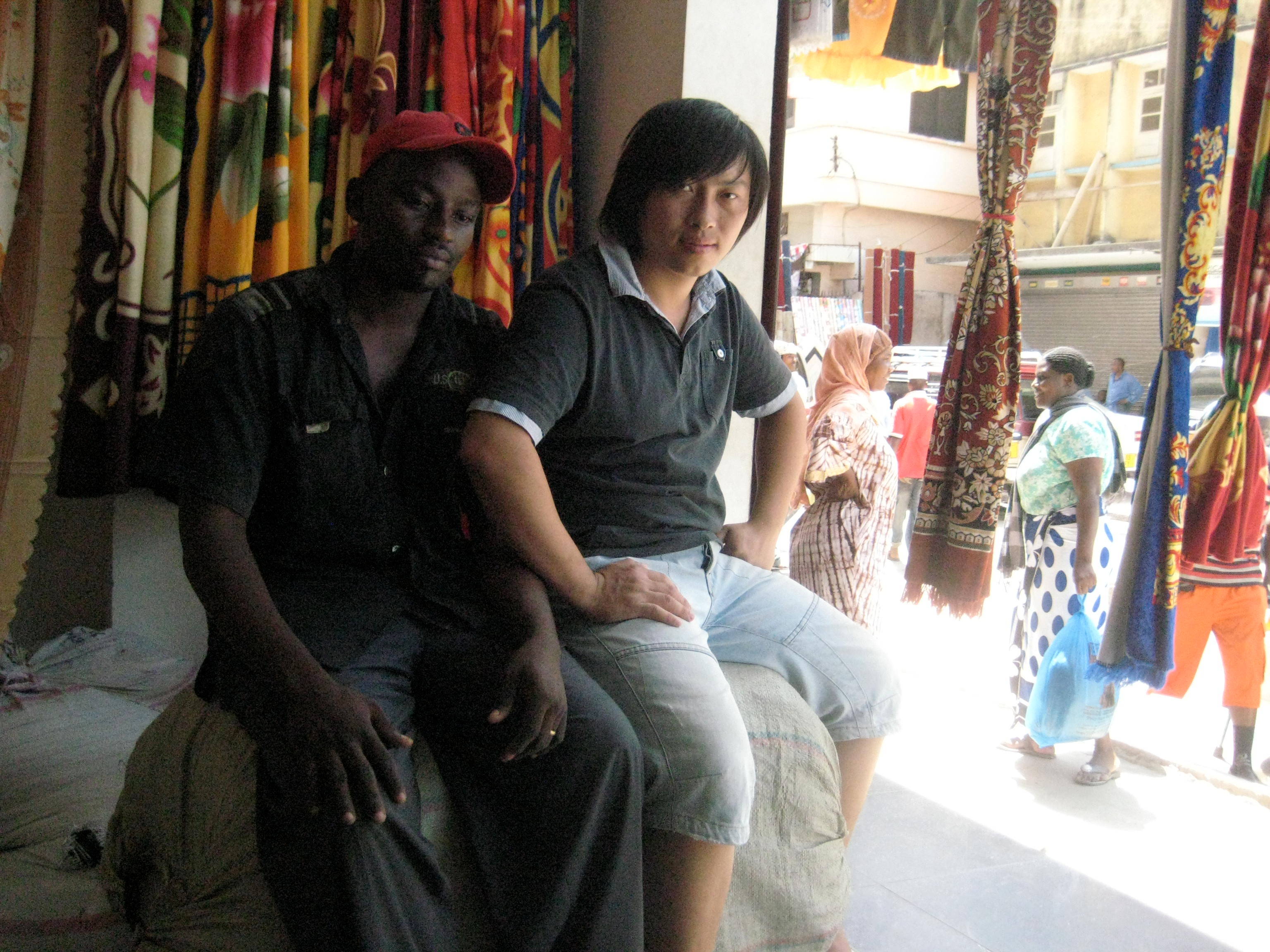
DAR ES SALAAM, Tanzania – Perched on a plastic chair in a wholesale fabric store in a working-class neighborhood here, Tony smiles.

“Most of the time, the local people are right to you,” he says. “It’s good to have different experiences. You can’t close your mind.”

The sanguinity is a little surprising. Tony (birth name Tau Fu, originally from Shanghai, China) has just described watching an armed robbery at the moneychanger’s across the street, his futile attempt to recover lost goods from a burglary at his storage facility, and the memory of another Chinese trader who was shot and killed in another stick-up.

Like many of the other Chinese traders who are arriving in Dar es Salaam and other major African cities, he is focusing on opportunities, not challenges. Mostly young and male, they travel thousands of miles from home to open markets for their cheap, mass-produced goods. They live in poorer neighborhoods than many Western expats but without ties to local communities, and stay for years at a time.

It can’t be easy. And yet they continue to come – more, it seems, every day.

Tony’s story sheds light on the migrant experience. The 27 year-old studied English in college and began working for the Kangxing Trading Company, a textile operation with its own factory. After two years of work, his boss sent him to open a shop in Tanzania, joining Chinese traders who had been opening businesses here since the 1990s.

Drawing on a mix of adventurousness and ambition – he was promoted to manager of his own store – Tony agreed. He arrived in Tanzania as an agent of the company, conducted market research for his boss, and opened up a storefront in Kariakoo, the cheapest area in downtown Dar es Salaam.

Tony estimates there are about 80 other Chinese-owned shops in the neighborhood, and there is a Chinese population big enough to give the area a feeling of an ethnic enclave in its infancy. There are now markets for Chinese food and a few restaurants scattered throughout Dar es Salaam. Chinese workers staff many of the stalls in the seething streets, selling shoes, fabrics and other manufactured goods.

At first glance, the traders have a good relationship with locals. Sitting in doorways, they slap five with passersby and trade jokes. Some speak Swahili better than they speak English. In Tony’s store, a younger Chinese worker and a Tanzanian employee sat on a bale of synthetic curtains and teased each other about their cultures’ differing preferences in women.

But not everything is so cozy. On the one hand, Tanzanians have welcomed the availability of cheap goods. There is also resentment, however. Some say the Chinese have undercut local traders. Their goods do not have a reputation for quality. Some people claim they have driven up rents in the once affordable neighborhood. For their part, some of the Chinese businesspeople feel unsafe. “It’s easy to rob Chinese people, because they’re not local,” Tony said.

In a fish market on the waterfront, local fishmongers trash-talked another Chinese textile trader, a 28 year-old named Ni Je, after he passed their stall.

“Mchina is no good,” a man said, using the Swahili term for a Chinese person. The seller gestured to a huge fish lying on a table. “He wants to buy this for 2,000,” he said, quoting a price in Tanzanian shillings that is a about $1.50.

Ni, who goes by the name Andy when doing business with foreigners, had not even expressed interest in the fish. But the judgment had been passed.

Ni says he doesn’t let incidents like the one at the fish market bother him. After all, he’s here to make money, and there are people who try to bother you everywhere, even back home.

As for the cheapness of Chinese goods in Tanzania, Ni says it is simple economics. “Chinese can produce anything,” he said, but African customers cannot usually afford the higher quality goods. So producers lower costs – and standards – to the point where the goods will have a market in countries like Tanzania, where 96.6 percent of the population lives on less than $2 a day, according to United Nations figures.

The first significant numbers of Chinese arrived in mainland Tanzania in the 1960s to build a railroad. Later, China sent doctors and invested in other big-ticket construction projects. At the diplomatic level, the countries enjoy friendly relations. In 2008, Tanzania was the only African country through which the Olympic torch passed during its round-the-world relay.

China’s presence in Africa is controversial. While African leaders like Paul Kagame of Rwanda have hailed Chinese investment in Africa, Western rights groups have criticized China’s business-first relations with alleged rights abusers like Sudan and Guinea.

For the smalltime businessmen in the streets of Kariakoo, though, the focus is much more immediate: a dollar earned, a rung climbed in the ladders of their careers.

As Ni put it, “Chinese people like to work – whenever, wherever, we don’t have a problem.”

Digital Utopians, Party Poopers and Real Revolution

There have been some snickers of late at the timing of Evgeny Morozov’s new book, The Dark Side of Internet Freedom (good NY Times review here). The revolutions in the Middle East supposedly gave the lie to his criticism of cyberutopians and their hypocritical Western government backers. I must admit I was momentarily caught up in the snickering — Facebook, social networking and more generally, the amazing advances in communications technology played a huge role in the overthrowing of Mubarak’s and Ben Ali’s regimes.

But two things have recently led me back to my fundamental sympathy with Morozov’s view (part of which I wrote about last year in one of my best-named blog posts ever, “Mao and the Facebook Panoptican“).

"My social network" by Luc Legay

One is the incomplete revolution in Libya, which has reminded us that although the Internet has made social networking more efficient than ever (it didn’t invent it, obviously), the price of change in violent systems will still be sweat, blood and sacrifice. And the Internet does not reduce complex history and politics — like that in Libya — into simple stories of good and evil that read like the Readers’ Digest version of Lord of the Rings (or worse).

Second is this short piece in Mother Jones about unabashed video game booster Jane McGonigal. The comments here from some of the notable cyperutopians are so patently, jaw-droppingly absurd that I re-realized how much we desperately need voices like Morozov’s. Take a brief look at this interview of Wired cofounder Kevin Kelly (referenced in the MJ article). Or McGonigal on the power of video games:

“When every family in the remote villages of Africa, or in what today are the slums of India, or throughout Nicaragua—when they and everyone else in the world has access to The Long Game, that will mean greater access to education, culture, and economic opportunity as well.”

Point is, even if his timing is slightly off — through no fault of his own — a smart cynic like Morozov is essential to taking this ridiculousness down a notch. (HT to my pal grist.)

I leave you with an Outkast classic you may find relevant… or at least good music.

Too much to keep track of

A few of my loyal readers have asked me why I haven’t been more vocal as of late. It’s a darn good question. The events in the Arab world in the last few weeks are a culmination of all the things that I have written about most on this blog.

Below, I offer a few rather pitiful explanations for my silence, which I hope you will indulge.

  • This is a particularly bad time for half-baked long-distance punditry. The information we have — and I am, of course, expecially thinking of Libya here — is mean and unreliable. With real lives in the balance, I have been reticent to contribute to the din without having firsthand information to contribute.
  • Events are unfolding too fast for me to offer the kind of thoughtful commentary for which I try to reserve this blog. My last post was practically irrelevant, news-wise, in about a day. Should I write a blog post about how calling the Libyan government’s apparent massacres of unarmed protesters does not qualify as genocide? (Which is how a number of interviewees, including defecting Libyan officials, are describing it on TV.) Such points are important (HT @texasinafrica), but it doesn’t feel right devoting a whole post to them from afar.
  • Most of all, there’s just too much to keep track of. I admit this reluctantly. As much as the wave of revolt washing across the MENA region emanates from some common urge for freedom, the local grievances of people are dizzyingly different from place to place. Bahrain’s Shiite majority is not Egypt’s multitudinous shebaab are not Yemen’s impoverished throngs are not Libya’s dying young people are not Syria’s somewhat more restrained malcontents, etc. The uprisings are all drawing from the same font of dignity, but they are nurturing different species of trees. Analytically, this makes it very difficult to comment on them en masse. And I would need to spend all day, e’eday blogging to comment on them all individually. Regrettably (for this purpose), I have a day job.

By way of consolation for these unsatisfying explanations, let me offer a list of what I am following in a vain attempt to keep up with everything.

Got recommendations for other good resources that I should be on? Please let me know.

Finally, a ditty I was thinking about for some reason today:

My thoughts with the people of Libya tonight.

ممكن يسقط؟ - Pic taken during unfortunate 26-hour layover in Tripoli airport, 2006.