Asserting citizenship as a Muslim

The founding fathers said it: "President George Washington, who, in a letter to the Jews of Newport, Rhode Island, declared that the United States, 'gives to bigotry no sanction, to persecution no assistance, requires only that they who live under its protection should demean themselves as good citizens.'" - from MoJo piece by Matteen Mokalla.

Make sure you read Matteen Mokalla’s piece from Mother Jones today about the absurdity of the “Ground Zero Mosque” debate and how it shows just how far our attitudes toward Muslims have pulled this country away from many of its ideals. You may remember Mr. Mokalla from past posts on this blog, where he answered questions about Iran’s election, articulated the ridiculousness of not translating “Allah” in news reports, and where I described riding shotty with him as we campaigned  for Obama in southern Ohio.

Which is, incidentally, where the key vignette in his post appears. Continue reading

Weekend jam: Ashimba

Tanzanian music aficionados will complain that this selection is old news, but for the rest of you, I bet this is new: Ashimba.

His music sounds to me like a sort of cross between Aurelio Martinez and Nameless, if that makes any sense. Definitely keeping TZ on my mind on a beautiful late summer day in NYC. How I wish I could link to Ashimba’s song Usingizi, which is the most addictive one. But it appears that this is the only music video he made from the album. There’s a sample from Usingizi in the last moments in the video. You can download Ashimba’s whole album here.

PS, Is this becoming a music blog? Not my intention, but I am trying to bring a new selection every weekend.

Weekend jam: allez Décalé Chrétien!

Nairobi’s Daddy Owen has taken Coupé-Décalé, the Franco-Ivoirian dance craze, to church with his praise song, Kupe De Kalle.

The song is at least six months old, though NPR just picked it up, so it’s been making the Internet rounds a bit more in the last few days. (The NPR article is oddly incomplete in describing the origins of Coupé-Décalé — doesn’t even name the style, which is several years old. For that, read the Wikipedia article.)

This is interesting and unexpected to me for a few reasons.

  • The distance between East and West Africa often seems vast. It is usually cheaper and easier, after all, to fly from Nairobi to London than it is to fly from Nairobi to Abidjan. (Read about some of the shenanigans involved in intra-African flights here.) Thus, talking to some Kenyans, for example, one often feels that people sort of think of West Africa as the bizarro world on the other side of the continent where life is unpleasantly loud and in your face. This song is an example of the digital breakdown of that distance — something that is increasingly common with high speed web connections.
  • There is a mild East African flavor to this version of Coupé-Décalé. It’s hard to describe. It’s not quite as hard-hitting, but a little easier to listen to while kicking back, than those joints from the Jet Set.
  • And Coupé-Décalé is a style that epitomizes raunchiness, ridiculousness and excess — not the genre you’d expect to be mined for church music. (Cue comment from reader revealing that there’s been a gospel Coupé-Décalé movement in the Ivory Coast for the last five years that I don’t know about.)

Check it.

Of course, music has always been one of those things that crossed African divides — borders, languages, politics, religion, great distance — with relative ease. So maybe I shouldn’t be so surprised. In any case, this is awesome. Makes me want to go put on some pointy shoes and spit some gibberish raps.

The importance of logging off

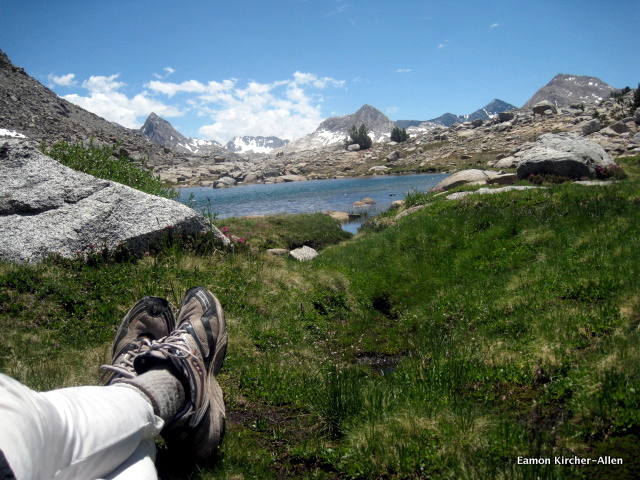
Just me and the mountains (no cell signal).

I was delighted to see the front page New York Times article today. Not only did it describe one of my favorite stretches of the San Juan River west of Mexican Hat, Utah — a river that gave me one of my first tastes of the wilderness as an eight year-old — but it also made a splashy introduction of some points that I think everyone will take more and more seriously in the next decade or so. Namely, that being constantly online shapes the way we think and process information, and that sometimes, we have to get offline.
Continue reading

Referendum Kenya

The big vote is tomorrow. (Pretty good article (I think) by Gettleman.)

In addition to the news, here’s what I’m watching: anti-apathy clips from Kuweni Serious :

(Browse through their stuff for some others featuring Makmende, like this one where dude is complaining about government efforts to encourage birth control.)

(HT to LL.)

On Planet Money’s “just give the oil money away” report

Photo by Jonathan Wheeler. Used with a Creative Commons license.

My favorite podcast, Planet Money, had a great report last week on a novel idea for avoiding the resource curse: just give the revenues away to a country’s citizens. The report was prompted by the announcement of huge deposits of precious minerals in Afghanistan and the discovery of oil in the last couple of years in Ghana — a country that desperately wants to avoid having its economy or government end up anything like Nigeria‘s, where there’s been a decades-long oil bonanza.

It’s easy to see the potential benefits of giving money away to poor people, if you’re at all sympathetic to the idea that welfare systems work to stimulate economies. Giving disposable income to people with pressing needs is great for boosting a country’s economic growth — a poor person who gets $100 will immediately inject it back into the economy by spending it on pressing needs, whereas a rich person might stick it in a savings account. Also, individuals may be better suited to decide what their needs are — and use money for innovative ventures — than bureaucracies, NGOs and government contractors (who might very well have corrupt relationships with those handing out the contracts).

But as you’ll see when you listen to the podcast, the idea is incomplete. Probably the biggest flaw is the fact that there are many collective ventures — schools, roads, hospitals — that individuals are in no position to take on, no matter how much extra income they have. (The advocates of the system would tax the transfers to pay for this, but it doesn’t seem like enough.)

Still, it’s funny to hear a Nigerian oil official in the podcast claim that individuals would do a bad job of allocating their payouts — it’s hard to imagine the situation getting much worse than it is when it comes to squandering the Delta’s riches.

It seems to me there’s a strong argument for having a big portion of oil revenues — but not all — earmarked for cash transfers. Whatever the solution to ending the resource curse and improving revenue transparency in extractive industries around the world, one important element is going to be getting more good journalism like Planet Money’s — but even more from local media — on the topic. Once again, I will shamelessly plug the report I wrote with several classmates on this subject: There Will Be Ink. Great title, huh?

K’naan stole the show

Here I am rambling on about war, politics and depressing things — and one of the most awesome televised concerts I’ve ever seen just aired. Makes American Super Bowl halftimes look like a joke, and I think it rivaled Obama’s inauguration. K’naan stole the show (look, I know I can’t be considered unbiased about the guy by now, but this was great):

Also loved Desmond Tutu, Vusi Mahlasela, Tinariwen and Vieux Farka Touré. (Sorry, you’re going to have to Google those.)

More on convergence of war and gaming

Yesterday, I described two different perspectives about what it means to fight wars remotely and through computers. I’m not a gamer, so I wasn’t aware just how similar video games are to the video from Wikileaks. If you had the stomach to watch that clip (beware, it’s extremely violent and disturbing), you will probably shocked to see just how similar the game Call of Duty is to the actual experience:

My point here is not so much to slam video games, but to suggest there is something remarkable — and awful — about this convergence of technologies. Entertainment, since its earliest forms, has always used war as inspiration. But until now it has been impossible to have a simulated experience that is so nearly exactly like the real one.

And it’s not that entertainment has chased war as much as some experiences of war — the remote ones — are becoming more like entertainment. Part of the appeal of entertainment that shows killing is that it removes all the nastier aspects of the experience — from the humanity of an enemy to the feeling of immediate vulnerability. Old west gunfights were probably nothing like those in High Plains Drifter. Saving Private Ryan might be uncomfortably real, but it certainly can’t be a substitute for participating in D-Day. The similarity between coordinating drone strikes, though, and playing Call of Duty seems unprecedented.

Does this influence how we as a country decide which wars to wage? It’s hard to say for sure, but there are certainly some interesting parallels between our foreign policy and the experience the technology helps create: god-like feelings of omnipotence, invulnerability, superiority, cold detachment from others’ suffering.

It is awe-inspiring technology, but it is also dangerous — not just for journalists carrying video cameras around the streets of Baghdad, but, I think, for the people pulling the trigger (or pushing the buttons). Or maybe I just think that way because my parents read me Lord of the Rings when I was 10.

(Hat-tip MB.)

Video game wars -The Times vs. Wikileaks

The New York Times just printed a gushing (one might even say jingoistic) report on how the military is using new technology to tap into Generation Y’s social networking skills to nail insurgents and protect American troops, all from thousands of miles away. Read the Times’ account, and you’d think this is mostly an exciting technology, which earnest, freckle-faced youths can use to scrub bad guys while they befriend their tougher colleagues on the ground, via chat rooms.

But as even that article acknowledges, the technology sometimes goes awry, like the time in February when Predator drones in Afghanistan snuffed out the lives of 23 innocent men, women and children — just one of many such incidents.

Well, here’s another perspective on what it means to turn the enemy (or those assumed to be) into pixelated blobs: Wikileaks’ video of a U.S. helicopter annihilating as many as 12 people in 2007 on a Baghdad  street, including two Reuters journalists.

I’m not embedding the video on this site because it makes me feel physically sick to watch it, and there’s really no commentary I can give that will add to its value. You will note, however, how much the clip looks like a short segment of Grand Theft Auto. Right down to the dialogue: After the first round of shooting is finished, a voice says, “Oh, yeah, look at those dead bastards” and another begs a dying man to pick up a weapon, implying that he’d then have a license to kill.

In some sense, this is just a raw dispatch from war. I’ve never been in a war, and I can only assume that its dialogue has been and always will be full of the most unpleasant things imaginable.

There is a particular coldness to this killing, though, and I think the technology has something to do with it. I hardly think we should celebrate it. The military says that rules of engagement were followed. If that is true, that is an indictment of the technology.

To see a sanitized version of the Wikileaks video, take a look at this BBC report on the detention of a US military analyst, possibly for leaking the tape.

Weekend jam: Melanesian Paradise

This song may have been commissioned by the Papua New Guinea tourism board, but that’s not keeping me from bobbing my head on this pre-Memorial Day Friday. Though I’ve never been to PNG, Solomon Islands, Fiji or the Trobriands, I am inclined — based on this song — to agree that, “with so many cultures living in peace and unity … we must all appreciate the Melanesian way.”

Anyone out there who can help with the pidgin (?) parts?

Thank you Haus Boi! (And HT to AK, who has been to the Melanesia paradise, and reports that is indeed pretty splendid.)