A car bombing killed 17 in Damascus this morning. Before we all start wild speculations as to who did this, based entirely on our prejudices and political convictions and no facts, let’s first express some sorrow for the dead. This is a heinous act. I am thinking of all Syrians today. Keep your head up, Syria… peace will come.
Middle East
Multimedia Activism in Palestine
A Space Station Called Dubai
I have come to think of Dubai as a space station: a place-less city in the middle of nowhere whose semblances of community, culture and soul are imported at great expense from elsewhere. The malls, bars and restaurants are of high enough quality to give the illusion of location, but the heart feels far away from earth.
Michael Slackman put it perfectly in this excellent Times article from today: “Dubai has been built along roadways, 6, 12, 14 lanes wide. There was no central urban planning and the result is a city of oases, each divided from the other by lanes of traffic. The physical distance between people is matched by the distance between nationalities. Dubai has everything money can buy, but it does not have a unifying culture or identity. The only common thread is ambition.”
One of the reason’s Slackman’s article is great is that it shows the positive side of Dubai from an Arab perspective: finally, there is a place where young Arab men can get paid, and their ability to work is respected. That’s a good thing. The dynamics Slackman describes are exactly those I observed talking to Palestinians who are now working in Dubai, having left the various countries of their diaspora. I was happy to see some of my friends finally getting paid like they deserve to be.
On the other hand, Dubai is a major destination for human traffickers, and the situation of the indentured South Asians of the labor camps is none too encouraging. Neither are the relationships between Western or richer foreigners, Arabs and South Asians. From what I observed in a brief four days, these groups didn’t mix a whole lot, and the comments tossed around by some Arabs about South Asians are hard to swallow. The men-to-women ratio is out of control. (An omission of Slackman’s article is an explanation of why he only interviewed men.) There’s a lot lurking below the surface.
That’s why I see the positive sides of Dubai not so much as a triumph of that bizarre, binging city, but more as a reflection of just how bad things are in the rest of the Arab world. There are no good reasons why the same opportunities cannot exist, in their appopriate contexts, in places less artificial than Dubai. What’s more, Dubai cannot sustain the whole region indefinitely.
Anyway, the story of Dubai is still unfolding, and I don’t think anyone knows what the phenomenon really means yet. Glad to see good reporting on it.
The Last Cedars of Lebanon

I’m already back stateside, but I wanted to write a few lines about my visit to Lebanon’s cedars in early August.
When you hear Lebanon, you think cedars. The tree is featured on the Lebanese flag, the cedar forests of Lebanon are mentioned in Gilgamesh — which is the oldest known written story — and any two-bit Beirut tourist shop will have trinkets supposedly carved from cedars. Which is why it is astonishing to see just how few are left. (At least in the main preserve, which is the one I visited. Apparently there is a secondary one in the Chouf that is quite a bit more extensive.)
In the reserve in Mount Lebanon, the cedars are confined to a few acres on a broad, denuded plateau at about 8000 feet. The winding road that takes you to them — with the anticipation mounting all the while — goes straight up from the sea through fantastic villages perched on the sides of chasms whose bottoms lie in shadow. You pass the village of Khalil Gibran — the famous poet who wrote The Prophet, a popular feature at 70s weddings — and churches built improbably on precipices. Bare mountain summits tug on shreds of mist. You’re almost there as the car climbs up through a final ravine…
Suddenly, the car passes through a 30 meter stretch of crammed stalls selling cedar-related tourist goods, and a few stately cedars begin to pop up on your right. Man, you must really be getting close to the forest!
But then you pull out into a treeless plain and there’s nothing in front of you except a bare mountainside with a lonely ski lift floppily hanging to it. Those few stately cedars were the forest. And barring a somewhat spotty attempt at replanting on the road to the entrance of the preserve, all the old trees have been cut down, literally to the edge of the stone wall surrounding the preserve. Inside, there are just enough trees — and some of them truly are sacred, thousand-year-old grandfathers that instill a lot of awe — that you can briefly be tricked into thinking you are inside a forest.

From a vantage point high on the mountain ridge above, however — where I drove afterward — the magnitude of the deforestation is clear. The cedars look like someone’s garden, perched on the lip of a high basin that must have once cradled a mighty forest that seemed inexhaustible to its early harvesters. The deforestation is probably a problem that dates back to ancient times, because there is very little evidence of stumps or the former forest. But based on the topography and climate, and my experience with clear-cuts in North America, it seems pretty clear that the forest was as large as I imagine (though I’d like to get a scientific confirmation).
It is a pitiful sight and one representative of Lebanon in general — so much has been taken from this country’s glory. Only a tiny glimmer remains, just like these cedars. Perhaps it is just barely enough to produce seeds, which if carefully protected could produce another forest of beautiful Lebanese cedars one day. Then again, the grove is also so small that a single catastrophe could easily wipe it out.
The sight of this grove also made me thankful for the systems of public land protection we have in the United States, something we need to continue to protect. We are extremely lucky to have as many national forests, parks, monuments and wilderness areas as we do. Let’s not take it for granted.
The South Wind of Summer Caresses the Hills…

I got a call around noon on Sunday — my last Sunday in Lebanon — from my capoeira friends asking if I wanted to come to the Bekaa to do a workshop for a youth camp.
Duh. Of course I want to go on a road trip with a bunch of capoeiristas to northern Lebanon!
An hour later, I was cruising up the Damascus Road in the back seat of a capoeirista’s jeep with a berimbau lying across the middle of the car. We came to the crest of the mountains and beheld the mighty Bekaa Valley. It was supposedly the breadbasket of the Roman empire, full of grains and fruits for nearly the length of Lebanon. Now, it still produces some of the best fruits, vegetables and wines, but it has been left out of the international trade loop, people say. It is relatively impoverished and development has bypassed it. Parts of it are home turf for Hezbollah. On the far side of this deep, broad valley rise the slightly more arid ante-Lebanon ranges. On their far side — in their rain shadow — lies Damascus.
The view has the same effect as the one that greets you coming over the Grapevine from Los Angeles into the Central Valley of California. You know, the view that Tom Joad sees in The Grapes of Wrath when his Okie convoy finally comes through the Mojave.
A little while later we were heading up the Bekaa listening to Salif Keita. We went through some small farming towns, where the people had a hard-bitten look to them, and there were Hezbollah and Amal flags everywhere. They run the show, and the Amal guys we asked for directions were completely helpful, despite the foreign appearance of even the Lebanese in our six-person group. (Amal is a political party allied with Hezbollah.)
Ahead of us was a thunderstorm: a good, old-fashioned, high-desert, afternoon-sky-blackening thunderstorm. My instructor — who lived in Albuquerque for years — and I immediately knew it was going to be a nice rain. We had a fun time arguing with the Beirutis in the car, whose conviction that rain does not fall in Lebanon in August under any circumstances was stronger than the evidence before them. Finally the blessed drops began to fall, and we stopped the car and greeted the moisture with out-stretched arms. Such refreshment is hard to come by down in Beirut.
We turned up into the hills to the west, and began a slow ascent through mountains that looked exactly like the semi-arid country of southern Colorado. The difference was that here, the soil was limestone, and the trees were not pinions and junipers but olives and other deciduous trees. They grew in the same evenly spaced patterns of a pinion forest. A breeze was blowing and I could smell the rain. I felt right at home.
In a small dale where the road was glistening from the recent rains, we stopped by a cabin where some apple trees were growing. A man in camouflage pants with a pony tail came out of the cabin. Some children and women were in the background.
“Hey, don’t I know you?” he said in clear English, with a decaying smile. He then proceeded to offer us “cocaine, ecstasy, hash — whatever you want.”
“Uh, no, we just wanted some apples,” I said in Arabic.
“Oh, OK, please have some. In the summer, we have apples. But in the winter we have cocaine, ecstasy, hash, only.”
It was a puzzling and light-hearted conversation. We had no interest in his more exotic goods, but we left with our delicious, fresh apples and drove above dark green fields of crops (you read correctly, Cypress Hill fans) to the camp where we were doing the workshop. The picture above was taken on the last leg of the trip, above the little valley where the hamlet is.
At the summer camp, we did drills with everyone in the late aternoon on a large stage. People liked it — the children were most enthusiastic — but their attention was mixed until we played in a huge roda and they got to see the acrobatics and contortion of the game. Then, with great enthusiasm, everyone taught us same dabkeh steps and played darbakeh beats on the African drums we had brought along.
We drank fresh cold water from a stream (hope that was OK, everyone was doing it) and ate a meal of fresh fish, fattoush and french fries. The full moon came up over the beautiful valley and the air was very cool (elevation about 1,500 meters). It felt just like a New Mexican village. We left despite the entreaties of several young men who begged us to stay and talked about American music with us. Most of the people in the camp were visitng from the middle of the Bekaa and thought of the locals as a bit backward. (Which was a little funny since that is how Beirutis probably view them.) The town looked like Hezbollah ran most major operations, despite the presence of a cursory Lebanese army post.
We cruised back out over the hills in the moonlgiht and told each other scary stories. I freaked everyone out with La Llorona, which seemed appropriate to the landscape.
Finally, we were back in the flats of the Bekaa, and drove by the awesome (not in the surfer sense — rather, the original sense of the word) Roman ruins of Baalbek. To make everything unbelievably perfect, we had the windows open bumpin’ Marvin Gaye as we drove past the towering columns and still-intact temples of the ancient city. So the denizens of the surrounding town got a nice taste of Sexual Healin’ before we left down. Which is really very appropriate for Lebanon, whether or not you are in a Hezbollah-dominated area. People like to live, and they are used to the outside world.
Anyway, that’s the story of my last Sunday. I gotta say it was a good day.
(PS The title of this blog is from a song by the band The Flatlanders. Listen for an auditory equivalent of the breezes I felt that day.)
Tripoli Tragedy
When I woke up this morning to the news of a horrific bombing in Tripoli (northern Lebanon) that killed at least 11 people, I swore I would not join the throngs of amateur (or often amateurish professional) pundits who leap to blame someone or other for this kind of strife.
But I have to point out how quickly people are doing just that. Check out this unfounded-in-fact editorial from NOW Lebanon, which blames Syria for the attack.
It’s gotten to the point where, any time any violence happens, folks just pull out their own agenda and slap it onto the vague facts of the case. There’s no sense of justice or accuracy in such games. Quite the opposite, they stoke hatred and suspicions. (Blaming Syria, in this case, implies certain sectarian and political abettors in Lebanon, which I won’t get into here.)
In a place where so many such crimes remain unsolved, I don’t blame people for speculating. But it would be nice to let people mourn and take stock of the situation before making wild accusations, especially if you have a voice that carries some authority. Using the event for a political agenda is terribly callous.
Anyway, I refuse to join the crowd of would-be experts and speculate about who is responsible. All the voices of such pundits gain steam until they are reported as near-fact on respectable websites. I just want to say that this attack — because of its timing and the fact that it apparently did not target any particular individual — especially requires some calmness and careful thought before allegations are made.
We’re not dealing with the latest rumor about an American presidential candidate’s extracurricular activities. We’re dealing with events that threaten to destabilize a country that is still very vulnerable to civil war. So if you’re in the media, be responsible and show some restraint before you start calling out names.
Midnight Oud to Beirut
It is getting quite hot here – it’s been close to 100 for the last few days, and combined with the humidity it can be stifling.
When I arrived in Beirut, I had a fantasy of sleeping with the floor-to-ceiling glass doors open onto the balcony, with curtains billowing and the dawn pouring in above the rooftops, probably accompanied by Cesaria Evora singing “Sodade”. But I discovered on my second night here that if you leave the door open, a mosquito is liable to single-handedly ruin your life, biting your face and droning ever more lowly as its gut fills with your blood over the course of a long, sleepless night. So to sleep, I close the door of my fourth-floor room and turn on the AC. (And if I don’t use the AC, I wake up in about a half hour drenched in sweat.)
The other evening was a very warm one, and just as I was dozing off the power went out, and with it, the AC.
In the ensuing quiet, I heard a strange sound. It was a haunting melody played on strings, so faint I couldn’t tell if it was my imagination or not. I got up and opened the doors, walked out onto the balcony and peered into the night, listening.
It was there, coming from the street below, where it was very dark because the electricity was out: the tremulous, smooth notes of an oud. The music filled the street for a few minutes and then stopped, and I saw the oud float up on the hands of a group of men sitting in front of a sandwich shop. It flashed in the ambient light like a gem, luminous, perfect and lusciously full-bodied, as more hands received it to put it in a car.
In the streets of Beirut, you rarely hear anything but the screech of tires and of horns and Arabic pop music blasting from fancy cars that, in their luxury, are incongruous with the pot-holed, rules-free roads. You see half-finished construction projects and garish ads for beauty products, cigarettes, alcohol and soft drinks. Haze obscures the mountains.
So hearing this oud – that most authentic of Arabic instruments, whose sound is the cry of longing – lovingly played in the silence of the midnight was like listening to a secret whispered about the real soul of Lebanon.
Beneath all of the scar tissue, it seemed to say, beneath the plastic consumerism and the chaos and the violence, somewhere in the tired soil of this land the seeds of its essence lie quietly in wait for the chance to grow again. There are still fingers that play those ancient, gentle Lebanese chords, though you may need to have a power outage in the middle of the night just to hear a few bars.
It is a theme on which I will expand in my next post, about my visit to one of Lebanon’s last stands of cedars.
"And Life Goes On"
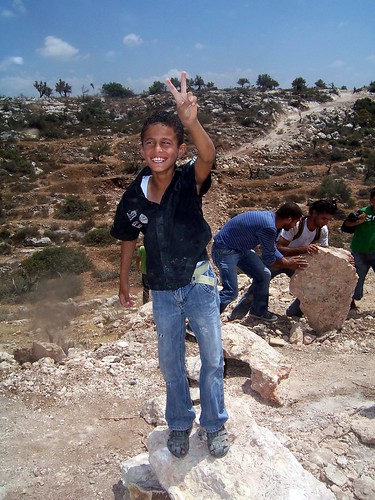 Every time I hear of a tragic, premature and unjust death, the Tupac Shakur song “Life Goes On” begins playing in my head. It’s what I listened to when Columbine happened, and when the war in Iraq started.
It’s what I’ll be listening to tonight thinking about the death of the ten-year-old Palestinian boy pictured above, who was shot in the head and killed by Israeli forces on Tuesday in the village of Ni’lin.
Lots of innocents die everyday in the Middle East and around the world, but this death holds special significance for me because the child was known to my friend and colleague Willow Heske (she posted this picture on her blog), who is working in Palestine for the summer. It also resonates because this child was shot during demonstrations against the “security wall” (more appropriately called the “apartheid wall”) being built through his village. The wall is a violation of human rights and international law, an attempt to ghettoize a people based on ethnicity and a harbinger of bad times. We should all be concerned about it, especially we Americans, because our tax dollars are indirectly financing it.
I don’t like hyperbole for these kind of matters — the tragedy speaks for itself. I just want to bring attention to this boy’s unnecessary death.
Paintballin’, Blowjobs and Hizbullah
OK, so if that title doesn’t boost my page hits, I don’t know what will.
It comes from a short service taxi ride I took the other day (in service taxis, you pay a reduced fee and then the driver takes other passengers along the way).
Two boys, about 19 or 20, are sitting in the back seat when I hop into the cab near my apartment in Hamra. From their nearly perfect American English peppered with a few Arabic bas, ballah and khalas, I guessed they were students at the American University of Beirut.
They are having the sort of conversation I used to hear among boys and girls on the back of the 24 bus in San Francisco on the way home from school – who did what sexually, how far they went, the scandalous context. Voice volume is typically elevated in a sort of exhibitionism: the conversation is as much for the other passengers as it is for the kids.
In San Francisco, these conversations are lurid, and at the same time painful. One has the sense that such working-class kids – often around 16 years old – want to tell the world their activities to convince themselves of the gravity of lives too often laced with suffering. A sort of public transportation therapy.
Back in the service taxi, the kids seem to be approaching similar topics from a different angle – one less crude but more annoying.
“Oh man, so she didn’t even give you a blowjob?” says AUB Boy 1.
AUB2: “No, man.” He pauses as a girl crosses the street. “Oh, I think I know that girl. OK, I definitely know her. I can’t forget that ass. That girl has a nice ass.”
AUB2 says this as if he is trying to convince himself that he really thinks this, and maybe to show off to his friend, and to me (foreigner) that he is capable of such comments. It lacks the rawness of the SF conversations, and the undertone. It is not mixed in with other talk about who got beat up, who has a gun and the excesses of intoxication, as it would be in SF.
These kids are privileged AUB students, even if they do live in war-torn Lebanon, I think.
“Hey man, you wanna go paintballin’ sometime?” says AUB1.
“Sure man, definitely.”
*****
If the middle-aged taxi driver with Islamic prayer beads hanging from the rearview mirror understood any English (I do not think he does), he might recognize the reference to paintballin’. He is Shia, I soon learn, and a staunch supporter of Hizbullah, so there’s a decent chance he lives in Beirut’s southern suburbs, where, incidentally, the local paintballin’ facility is also located.
As we drop off the kids in front of AUB, the conversation between me and the taxi driver turns to politics. (It’s inevitable; I should never have told him I am an American. But lying – even little lies – is almost as exhausting as these political conversations.)
I learn that the taxi driver holds Sayyid Hassan Nasrallah in very high esteem. “He is the only honest politician in the world,” he says, or something to this effect. I am still getting used to the Lebanese accent, and my comprehension veers from total to foggy. He says America should leave Lebanon to its own affairs, he complains about Rice and Bush.
I agree, but I draw the line when he says Barack Obama is a liar. The driver is mad because, he says, Obama kicked out two veiled women from a campaign event. (A story based in some fact, apparently.)
He drops me off in a cheery mood – I always seem to be able to effect this with taxi drivers – and I walk by the bars of Gemayze to work.
*****
Woah, I think. These are the paradoxes of Lebanon. What will be the “conversation” that occurs between the Blowjob Bros and this taxi driver’s children one day?
Maybe what they want is not so different. Maybe, because of my vantage point, I have seen the same thing from different angles. I hope so.
Mama Syria: Some Anecdotes from Homs
Last Friday evening I leave late with my friend Ghaith for Homs, his home city, two hours north of Damascus. He is a little disappointed – he would have liked to leave earlier, because he wanted to show me the countryside and a village. But I had meetings with other friends all day, and couldn’t get away.
Ghaith is like all my Syrian friends in that he is desirous of my time and utterly generous at the same moment, demanding a lot from me and giving me even more. There is no reasonable request to which he would say no. He and others try to give me money, insist I eat from their refrigerators when they had little, use their cell phones, act as if they were personally insulted when I tell them how a cab driver overcharged me.
Ghaith complains about the condition of Christians in the Arab world. He also clearly loves Arab cultures. He is enthralled with old poetry and romantic songs. Arabic is his mother tongue, and the only language he speaks fluently.
We take turns testing each other’s translation skills by listening to songs on my iPod on the bus to Homs. I play him “Imagine,” by John Lennon, and he likes it a lot, though he seems not too sure about the line “imagine no religion.”
We get into Homs by 10:30, in time to eat dinner with Ghaith’s family. They are barbecuing on the tiny balcony of their small apartment in a nondescript block of housing somewhere in the sleepy city.
The breeze is blowing, a fact about which Homsis seem proud.
“Fi buroud bi Homs, ma?” Ghaith says with a smile. There’s coolness in Homs, no? (Something those big-city Damascenes can only dream about: Homs is on a high, cool plain.)
I sit on the couch and watch Turkish soaps dubbed into easy Arabic with his sister. Every so often Ghaith taps on the glass sliding doors and insists that I eat a succulent morsel from the kebabs.
We eat dinner with glasses of araq on the rocks. Ghaith’s father, a craggy man with a prominent pot belly, gnarled strong limbs and a bottlebrush mustache, tries to crack jokes with me in broken English, which makes the Arabic in between that much harder to understand.
Ghaith’s mother, a stout, dark-haired, doting woman, keeps emerging with more plates of skewered meat, onion and tomatoes. Slight beads of perspiration form on her brow.
Afterward, while the women do all the cleaning up (I try to insist on helping, an idea greeted as ridiculous for the double reason of me being a male and a guest), the father regales me with tales of his time in the United States, where he spent several multi-year periods.
His face is a grizzled, sun-burnt crimson above his A-shirt as he tells of the time robbers put a gun to his friend’s head in an L.A. convenience store where he was working and he had to get the “Mexican woman” next door to call the police. He has been to Las Vegas “many times.” One time the police pulled him over and he told them he was French, and they let him go. He switches to English to mimic, rather unconvincingly, the voice of the woman who “wanted to marry” him when he worked at “the store” in L.A. He calls black people “abeed,” which I hate. (It means “slaves” in Arabic and older people often use it.)
“You can’t say that, Dad,” Ghaith says, knowing I am offended.
The father says America is beautiful, wallahi al-azeem. He can’t go back now because he overstayed his last visa.
Ghaith’s father’s physique and presence would seem to be the result of a peculiar combination of habits. He smokes two packs a day and generally does not eat vegetables if they are not accompanied by meat. He also rides his bicycle 10 kilometers a day to and from work.
Then, in the dialect of the Bedouin, he can recite beautiful poems called Baghdadis. His family is from eastern Homs governorate, on the edge of the desert. When he was a child – and the family had already moved to the city of Homs – bards would sing these songs, and he would memorize them. The poems have several lines ending in a word that sounds the same but has a different meaning in each case. They deliver an emotional punch even when I have no idea what they are about.
I imagine the father as a small Christian boy at the feet of a roaming bard in a dimly lit village, hanging on every word, as his whole family and I are doing now. No one besides the mother understands the Bedouin dialect in which the father sings the poems, and he must explain them.
The foreign words bring to mind the vastness of a dark desert, a place where the stars are the brightest thing at night, and life’s longing is undisguised. The songs are about lost love.
Back in his room in Damascus, Ghaith plays for me Bedouin songs that he has saved on his mobile phone.
“You understand that one?” he grins. “That one’s impossible.
“He’s saying that he is in love with a girl and wanted to marry her. She agreed, with the condition that he break his relationship with his mother.”
The singer wails and repeats the line.
“He’s saying that when your mother sees your silhouette in the desert from afar, she cries from camp to greet you. She doesn’t care about how you look or what you have done.
“But when the girl sees your silhouette in the desert, she tries to reckon your appearance before she rises to greet you.
“The girl is beautiful, she has the choice of many men in the world; for your mother, there is only you.”
What does the suitor do in the end?
“Ha, he stays with his mother,” Ghaith says. He clicks off his phone and reaches for hot water, to fill our glasses of yerba mate.
 Eamon Kircher-Allen