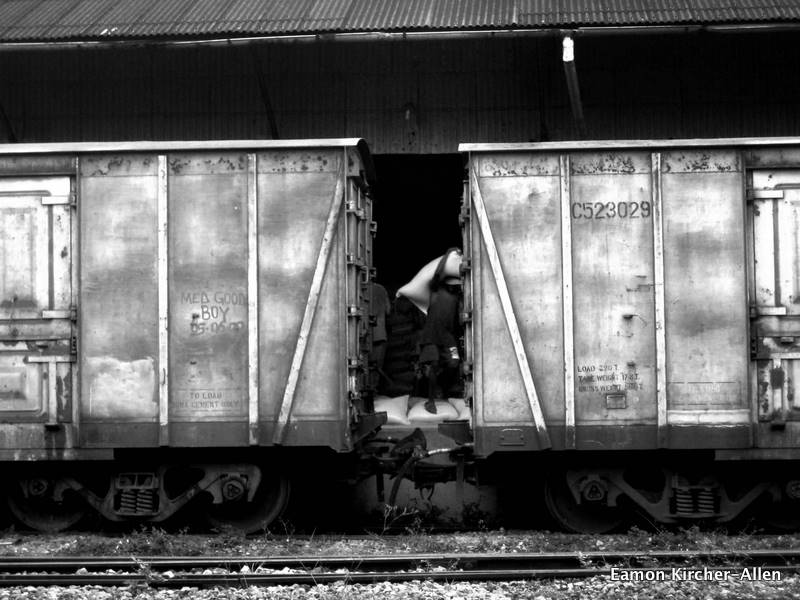
Check out my freshly published audio slideshow and article on the “Lunatic Line” from Mombasa to Nairobi in Kenya.
Check out my freshly published audio slideshow and article on the “Lunatic Line” from Mombasa to Nairobi in Kenya.
A sad building in Kisumu, Kenya, which is a very pretty city. Much of Kisumu burned in the 2008 post-election violence, but those trees look too old for the damage to be recent.
 During this epic 18 hour ride from Nairobi to Dar es Salaam (really, not recommended — do it in two days) we got a flat on the high savanna below Mt. Meru, and were detained in the Arusha police station for nearly two hours. There was a passenger who was supposed to get down there but refused; the police made everyone wait while they took statements from the bus company people and the passenger. I’m not even sure what happened in the end. My eyes were red and nerves frazzled by the time we pulled into Kariakoo.
But views of vast Africa through poetically dirty bus windows, like this shot about three hours south of Moshi, made it all worth it.
Heading out again tomorrow.

In the last week, I came across two pieces of media about conflict that impressed me. One is a book called Kenya Burning. The other is a movie called This is Lebanon (Hayda Lubnan) that I saw for free at the Kenya Film Festival (sweet!). Continue reading
Not much! Except that a guy was selling posters of all three on a sidewalk near Kariakoo the other day. Also, check out the awesome Rambo bag distributed at the local vegetable market.

"You could love me or hate me/I swear to God it won't make me or break me..."

It's like they finished designing this bag and thought, "Crap, we didn't include any cpoyright violations. What can we slap on here?"

These young Zanzibari men go by the names of U.K. (left) and Kheiry. They’re dressed up for Eid al-Fitr festivities last week. Read, watch and listen to my multimedia report on GlobalPost.com.
ZANZIBAR, Tanzania — The morning of Eid al-Fitr broke in the narrow streets of Stone Town, Zanzibar, with a few minutes of intense tropical downpour. It was a fitting start to a day that celebrates the closing of the holy month of Ramadan — a day when everything should be clean and refreshed.
Stone Town, or “Mji Mkongwe,” as it is known locally in Swahili, is the oldest section of the main city on the island of Zanzibar, Tanzania. It has lain at the crossroads of vast Indian Ocean trading networks since ancient times. Today, it is a hub of Swahili culture, which thrives on the eastern coast of Africa, stretching from Somalia to Mozambique. With influences from mainland Africa, Arabia, Persia and India, the enclave’s people, architecture and customs capture the eclecticism of Islamic life. Continue reading…
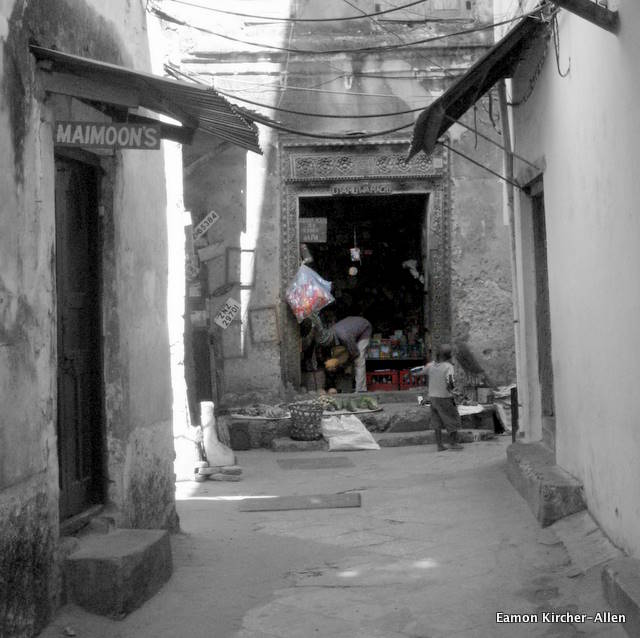
Just a slightly doctored image from my four-day sojourn in Zanzibar covering Eid. I know the focal black and white thing is a bit gimmicky, but I thought it worked here.
Internet is down in my hostel (man, I have gotten so spoiled), so new LGD posts will be a bit intermittent for the next few days. Please bear with me. Eid Mubarrak!
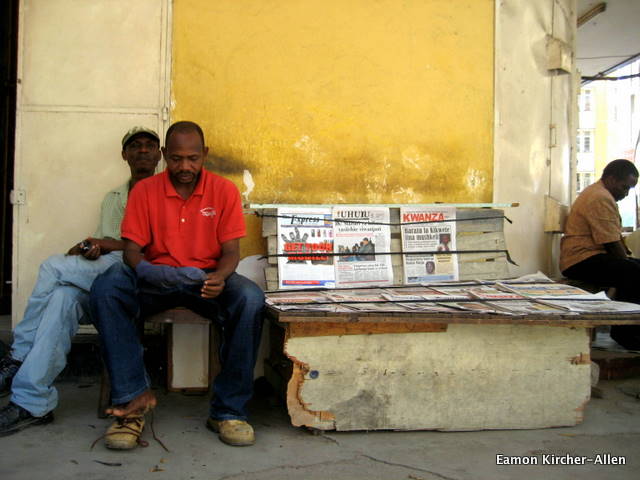
Selling the newspaper in the Kisutu neighborhood, Dar es Salaam, Tanzania. Tanzania boasts scores of English and Kiswahili publications.
 Eamon Kircher-Allen