As a brief follow-up to my last post, it appears I’m not the only one point fingers at U.S. policy for screwing up Somalia. Short article.
Politics
Sometimes Afghanistan is just like Gaza
‘In a statement, Colonel O’Hara said, “[F]orces exercised great restraint and prevented any civilian casualties at the same time the enemy placed the whole village in harm’s way by operating the way they do.”’
Besides the fact that O’Hara is an unlikely last name for an Israeli colonel, it’s hard to tell whether this statement applies to Gaza, Iraq or Afghanistan. In fact, it’s part of an American response to accusations that U.S. Special Ops killed 13 civilians in a raid on an Afghan village this month.
As the world (rightly) remains outraged at the destruction in Gaza, it’s good to remember that the U.S.A. continues a similar campaign in Afghanistan. The parallels should not be overstated–after all, Afghanistan is not our neighbor as Gaza is Israel’s. But these Afghan civilian deaths seem to take place further from the world’s attention than those in Gaza.
Let’s keep our eye on them, and keep pressuring Obama to make changes to his policy in addition to his rhetoric.
A president who’s not an idiot
So this is what it feels like. It’s so beautiful that Obama has chosen Al-Arabiya as the venue for the first interview of his presidency (though it is sort of the Fox News of Arab media, in terms of its orientation). And it’s beautiful that he has chosen to use words and language to redefine the way America will deal with terrorism. This is important.
Now, we’ll all be waiting for some changes in policy. Because of course, the way Bush described things was the smallest problem of his “leadership”.
Come on up for the rising! Obama is president
It was insanity. Complete chaos. It took a half hour just to get out of the Metro—in Chinatown, no less, about a mile away from the area to which my tickets supposedly entitled me entry. I didn’t even get to lay my eyes on the man himself, Mr. Barack Obama, the 44th President of the United States. (For a full description of the ordeal with the crowd, see my last post.)
But that wasn’t what inauguration was really about. Just like standing in line yesterday for the tickets I barely got to use, it was about being there, being a part of the seething millions who greeted this day together. And even though I didn’t see the man himself (except for his distant image on a jumbotron), I did, in a sense, see the real Obama: all of those people who came to show their support for the change that finally came.
The way I see it, we are Obama. His election is about us, coming together as American people and rejecting the politics of fear and division. Thinking independently enough that we could elect someone from outside any political dynasty, with the middle name of Hussein, with limited national experience and an attitude that, in the end, we’re all in this together. Continue reading
Inauguration crowd control nightmare worth it to help usher in a dream
Here’s what happened. My aunt, my cousin and I left Alexandria, where I was staying along with 13 family members (the Allens rolled deep on this one—and that’s only about 10 percent of us). We caught the yellow line with the intent of transferring to the blue line, as the instructions on our ticket indicated we should do. But mid-transfer, a perplexed-looking train employee in a fluorescent vest told us that getting on the blue line was impossible. Sure enough, the blue line train was packed to the gills, despite being near the beginning of the line, and we had to get back on the next yellow line train.
It was the first episode in a series of vast crowd mismanagements that would have ruined the day were it not for the attitude—collective, I think—that it was more important simply to be present than to have the personal gratification of getting to see Obama. Continue reading
At the inauguration, solidarity and joy, even standing in line
I’m in Washington, D.C. for the inauguration of President Barack Obama (doesn’t that feel nice to say?), and like about a million other people I spent the day shuffling through crowds in 34 degree weather. It was slow going, with lines for eveything — to get into museums, to get on the metro, to get a cup off coffee.
But the atmosphere was like a love-in. People were smiling at each other, talking to strangers (no one was a stranger, in fact), expressing their happiness about the moment. Strolling around the frozen pond before the statue of General Grant and the Capitol Building — where the inauguration will take place tomorrow — there was a solidarity in the air.
I guess that’s why standing in line for three hours for inauguration tickets at Nancy Pelosi’s office was bearable — even enjoyable. It was all part of the experience. All the legislative office buildings had lines stretching for a block and a half, and Cannon House was no exception. But my dad and I spent the whole time getting to know our neighbors. Continue reading
Inauguration exclusive: the audacity of hoping for a better U.S. policy toward Syria
LGD Note: I reported this piece back in October and wrote it in November for a class at Columbia, with the intention of publishing it on a foreign affairs-concerned website. At the time, the handful of advocates for a better U.S. policy toward Syria were sounding optimistic. Then came the U.S. attack on the village of Sukkariyyeh in eastern Syria, which brought relations between the two countries to an all-time low. It also complicated my story in a way that I couldn’t untangle during midterms. I offer the piece here with the caveat that all comments were obtained back in October before the attack, and long before the Gaza war. But I think there is some interesting food from thought here that is relevant despite all the things that happened since I reported it. What kind of change will Obama bring to our policy with this overly maligned country?
***
By EKA
November 15, 2008
American voters aren’t the only ones celebrating the election of a new president this month. In Syria, which is still reeling from the October 26 attack by U.S. commandos on the village of Sukkariyyeh, people are hoping the new presidency will mean a different American approach to their country. Continue reading
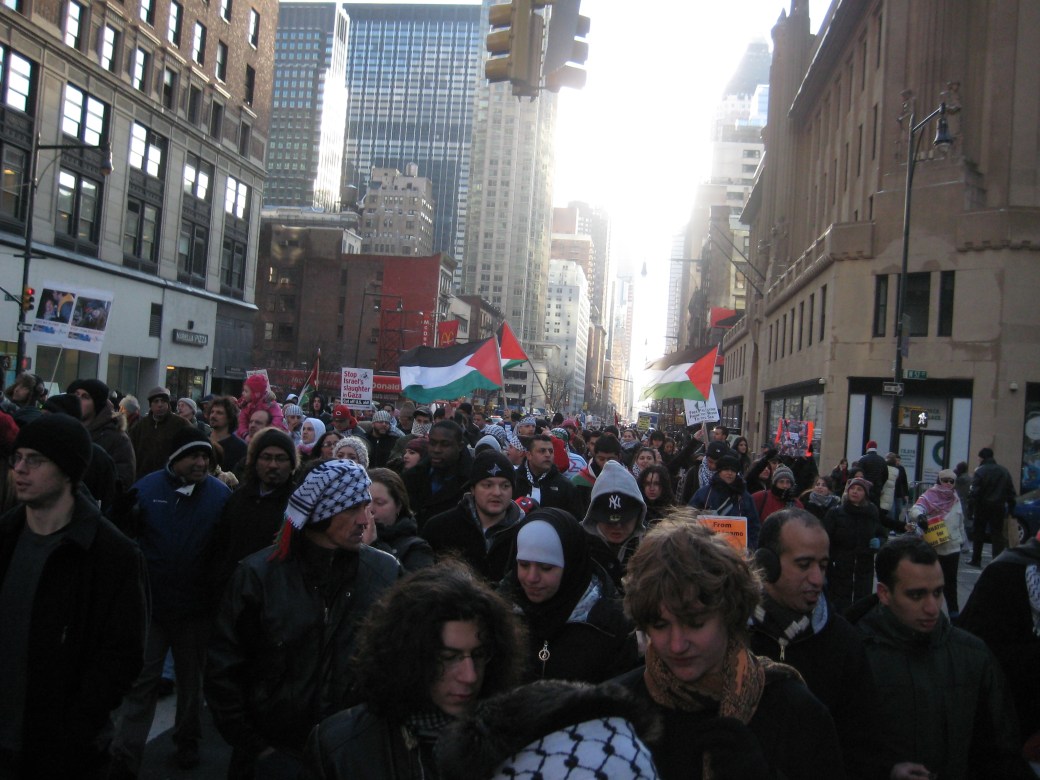
March for Gaza in Times Square
Just wanted to share a pic from today to show the world that there are some Americans who really care about what is going on in Palestine. We marched from Times Square to Columbus Circle. It was peaceful and bitterly cold. Someone told me there were 20,000 people there, and I could believe it.
Jon Stewart keeps it real for Gaza
If Jon Stewart was a total partisan about anything, he wouldn’t be doing his job. So I expect him to be more cynical and keep a better critical distance from the bombardment of Gaza than I have been able to do. (But hey, I don’t think I’m doing such a bad job myself!)
Still, it was a huge relief to see him joking about the Israeli incursion in a way that made all the Israel apologists on TV look like dum-dums. (They tend to be much more annoying than Israel apologists in real life, because their position on the matter seems much more a political stunt than actual conviction.)
My favorite part of Monday’s show: New York mayor Michael Bloomberg asks, If a crazy neighbor was shouting through your door threatening to kill you, wouldn’t you want the NYPD to send all available resources, not just a single cop?
“That depends,” says Stewart, “if I was forcing that person to live in my hallway and pass through a checkpoint every time he needed to take a shit.”
LOL
Palestine: get on the bus
Wouldn’t it be embarrassing to look back at the year 1983 and recall being on the fence about Apartheid in South Africa?
“Gosh,” you thought, “I mean, I don’t think it’s ideal that blacks and whites are separated in that country. But S.A. does plenty of good things. And I can’t imagine those wild terrorists, the ANC, taking over.”
I hope I’m not really describing you here. My point is, with the power of hindsight, it’s hard to see how anyone would have shied from denouncing Apartheid, let alone openly supported it. Yet plenty of powerful people stood by while one of the most ruthless and distasteful political systems in modern history thrived for more than 40 years. Our own Reagan administration blocked sanctions against South Africa and believed the racist government could be nudged toward reform by helping Apartheid’s architects get richer. (His plan didn’t work.)
Nearly 20 years after Apartheid ended in South Africa, the world finds itself at a similar juncture with regard to the Palestinian people. With Israel’s blasting of Gaza, there’s no better time to make sure that, 20 years from now, you don’t find yourself in your own embarrassing hindsight moment. It’s time to get on the bus for the Palestinian people, especially if you’re an American. It’s time to demand that Palestinians receive the same rights that Israelis have. That they have the same opportunities to live long and prosperous lives. That they are not physically confined to walled, impoverished homelands (like the black “homelands” in South Africa) based on their ethnicity. Continue reading
 Eamon Kircher-Allen