New York City Mexican Food Challenge: Any Tips?

There’s a place on 16th Street between Valencia and Guerrero in San Francisco where you can get one, delicious soft-sided taco for $2.95. It comes with fresh salsa, grilled chicken, onions, radishes — and a heaping portion of homemade tortilla chips. Get two of those babies and an horchata, and you are good to go for the night.

Every hood in San Francisco has its own taqueria highlight, especially the Mission, Outer Mission, Excelsior and Bernal Heights. I grew up taking them for granted.

No more. After a year in New York, I have not been to a really good Mexican or Central American restaurant in the city that supposedly has everything.  (I have been to some pretty terrible ones. Think the Amsterdam Chevy’s, if that exists. I found a place like that on Flatbush.)

On Saturday night I made the mistake of getting hopeful. I was on Houston and went to a little joint named El Paso. The owners made an effort to have a nice classy feel, and the waiters wore ties tucked into their shirts above little aprons. Prices were commensurate with the location and ambiance. They were not, unfortunately, commensurate with the food: cheesy and lacking spice. The salsa looked like bean soup. The meal was preceded by a salad (?) of iceberg lettuce with “Italian” dressing.

Then I realized: There is a taqueria in a car wash in San Francisco that serves better Mexican food than the best Mexican restaurant I have been to in New York City. I’m talking about Bayshore and Army/César Chávez right there at the intersection of Bernal, Bayview, Mission and Potrero.

What’s the deal, people? New Yorkers say I’m hating. There’s a taco truck in Queens that does it right, they say. I don’t know, but I think a taco that takes an hour to get to doesn’t count. Does that mean there’s nothing in the island of Manhattan?

I invite my ten regular readers to submit some suggestions, because I’m at a loss. And please don’t recommend the spot on Amsterdam and 108th. It’s close, but I’m looking for the real thing. I’ll privilege suggestions from Californians living in NYC.

Gentrification: Same Story from Harlem to the Bay

When I was walking a friend home in Harlem near 118th and Adam Clayton Powell Boulevard in May, a mumbling, stumbling man crossed our path. I caught a few of his words.

“Back in the day, a white person would get robbed at this hour in Harlem,” he said, among other things. (I’m white; my friend is a black grad student; the man was black.)

I was annoyed on a personal level, but I did not feel surprised or wronged. I can hardly blame people in the neighborhood for feeling more than a little uneasy about the incredibly rapid changes that are happening in Harlem, especially south of 125th Street. Harlem has long been the capital of Black America and a beacon of culture in America’s most repressive times, even though it has also seen (so I read) its own ups and downs. And suddenly, it is becoming full of chain stores and upscale cafes full of outsiders.

I thought of the mumbling man when I read about “root shock” in Harlem in this article in the Times. One of the most startling things in this article is one longtime Harlem resident’s claim that he was happy that shootings happened in May, because it would at least scare off the newcomers.

I got to thinking: A big part of the problem is not only that the neighborhood is becoming more expensive or that new people are moving there, but also the insensitivity of some of the people who are gentrifying. (As a white grad student, I’m one of those people, whether I like it or not, though I am trying not to be so insensitive.)

Rather than adjusting to the neighborhood and accepting the existing stores and institutions, people want to bring what they are comfortable with to the new environment and keep Harlem’s African American culture as a sort of decoration on the top of their routine of wine-bar- and Starbucks-patronizing.

It’s like, if you move to Harlem, fine, but can you not walk your poodle while chatting on your cell phone and sipping Starbucks and throwing all the symbols of your white, outsider power and oblivion into everyone’s face?

I think sentiments like those of the guy who said he was happy there were shootings actually come, in part, from people living through Harlem’s most hopeless days, and knowing all the pain and struggles and strength it took to stay in the neighborhood when crack cocaine was at its peak, and then seeing that history erased and other people building their fantasies of cheaper good living on the ruins of that. (Here’s a great video clip on about the same subject.)

I’m not sure people who live through gentrification and hate it — and that includes me in my native Bernal Heights, San Francisco — really know what they want or how they can stop big changes, in the context of a capitalist society.

But I am sure that if the neighborhood was being changed in a way that respected what was already there and had some continuity with the past, the anxiety people felt would not be so acute.

You’re Way Too Beautiful, Girl

“You know how I feel about San Francisco?” I said to my friend as we cruised out of Golden Gate Park toward Ocean Beach on our bikes about two weeks ago. It was a warm day, and a cool ocean breeze was settling on Beach Chalet.

“You’re way too beautiful, girl, that’s why it’ll never work. You’ll have me suicidal, suicidal, when you say it’s ov-er.”

He laughed and let out a “Whooo!”

We grabbed a cup of coffee and a brownie from nearby Java Beach Cafe at Judah and the Great Highway, and settled into the dunes to enjoy the view pictured above — on that day and about six others in the last couple of weeks.

It’s true. The City is just too damn nice — it’ll have you damn near suicidal when your visit is ov-er.

I spent the last weeks there savoring every moment in its mild air and soft light. It is beautiful yet unpretentious, full of street fairs and book stores. Not too much noise or too much consumption. People are united in some sort of unspoken agreement about a general set of priorities: community, outdoors, good times, good food, good music, liberal values. (Any side of the debates we have about the City’s future share these, but have different ideas of what they look like.)

I had to leave before I got too attached. Even so, wrenching myself away was painful. Here are some of the highlights of my stay in my city:

Biking across the city, over and over again
If you are in moderately good shape, you can get from almost any point in San Francisco to any other within an hour. I took advantage of this as much as possible. Avoid hills wherever possible if you need to move fast. (Search them out if you went to see less-traveled corners.) My preferred cross-city route (Bernal Heights to Golden Gate Park, for example) is Mission-Valencia-Duboce-Fell. You feel the different vibe of every street and empty out into towering Monterey Cypress in the Panhandle, amidst basketball games and weed aroma.

Sunset at Ocean Beach
If I live long-term in SF again, I’m doing this at least twice a week (on vacation I tried to do it everyday). There is nothing like the wind in the dunes and the wild Pacific to put everything in perspective. Doesn’t cost a thing.

Take the 14 Mission
I take this bus to hear the stories of the people in my neighborhood.
Common said it best in Black Star’s Respiration (minute 3:42):
“So some days I take the bus home, just to touch home
From the crib I spend months gone
Sat by the window with a clutched dome
Listenin to shorties cuss long
Young girls with weak minds, but they butt strong”

You could spend two weeks on the 14 and write a novel with the material you observe and hear on the extra-long bus.

Nightlife: Guerrero, Valencia and Mission between 16th and 24th
The most unpretentious place is Skylark. I have the best time at Baobab and Elixir. You will not find the glitz of L.A. But you will find a lot of down-to-earth people who are beautiful in a totally different way. This is only a small sample of what San Francisco has to offer, and I recommend it all. (Although I usually don’t venture to the Marina. Yuck.)

Day-trip to the East Bay
I always felt like the East Bay — especially Oakland and Berkeley — and San Francisco are equal partners in the Bay family. I try to go at least once every time I am around. You can’t go wrong with Ethiopian food on Telly, ribs on San Pablo, Indian on Shattuck, or a walk around Lake Merritt with someone cool.

Dwelling in the Southeast
Bernal Heights, Portola Heights, McLaren Park, Outer Mission, Cayuga Park, Lakeview and Ingleside, Bayview and Hunters Point: Take your bike throughout the neighborhoods, turn down side streets. Every corner has its own character.

Anyway, don’t worry for me. My visit is over, but I’m not suicidal, just in pain. Turning over San Francisco memories in my mind is kind of like reading old love letters stumbled upon while cleaning your closet. They might bring you a tear or two, but you can’t help reading them one more time…

So Turns Out I Still Love the 415

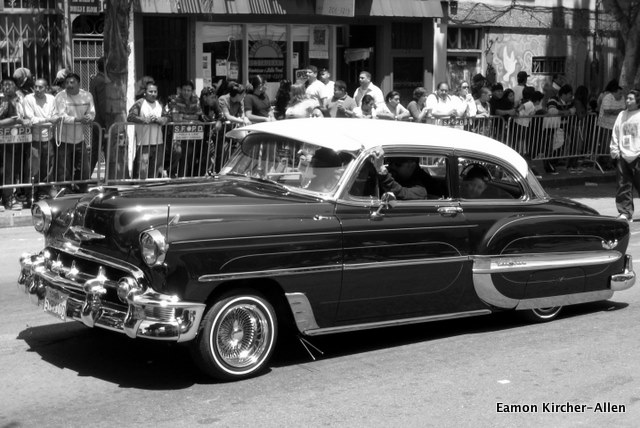
Mission lowrider

Carnaval in San Francisco always means 65 degrees in the Mission District, sunshine and seabreeze, pepper trees and pupusas, low-riders and samba dancers.

I went to Carnaval last weekend in the hope of being taken back to childhood memories of Carnaval in the late ’80s and early ’90s — a time I’ve idealized as the last years of a San Francisco dream of diversity, low-cost living and creativity. What I found was that, despite all the changes — demographic shifts and rising costs — San Francisco still has a lot of soul.

Back in the days of my reminiscence, as everyone knows, the Mission was a bit different. Fewer of the Victorians were renovated. The Valencia Street Gardens housing projects were there and gave Valencia a different character (it wasn’t the epitome of post-dot-com Mission trendiness it is today). There were a lot of down-and-outs on Valencia Street — I remember that my brother and I loved to go eat there because the ramblings of the crazy people were as good as any street theater. It was thrilling.

The Soviet-style Army Street projects loomed ominously above Harrison and Army. I remember them as massive towers, and I still see the graffiti murals on their sides in my mind’s eye.

Now, the Valencia Gardens are being rebuilt (to the City’s credit they will include even more units than they originally did). The Army Street projects were demolished and replaced with affordable housing of a smaller scale.

Dolores Park was run by drug dealers who slanged their wares on the J tracks. (Now hippies do it semi-legally as they walk amongst the hipsters in the park).

It’s all neither here nor there, really. Good changes have, I suppose, come with the bad. But it is often jarring to see how many things have changed, and to see how much the street and community life has been affected. Carle Nolte accurately summed up the changes in a January Chronicle column on the changing San Francisco in which he described it as a “boutique city”.

So even as I searched for memories of my childhood Carnavals last Sunday, I walked to the Mission from Bernal Heights with a sense of apprehension. Would anything of the old neighborhood be left?

Indeed, plenty remained. Twenty-fourth Street is still covered with murals and lined with local business. Reasonably-priced taquerias, corner stores, football games (on an improved field in Garfield Park), sunbleached Victorians — they are all still there, in the midst of the Priuses, dogs, yoga centers and remodeled houses of some of the newer residents.

The colors were impossibly vivid. The families were all out in full force. Jeans were sagging. The “SF” emblem was everywhere — ball caps, t-shirts, customized sneakers, tattoos. Pullovers read “Giants”, “Gigantes” and “Tha Sco” above a throwback Warriors motif. Hairstyles were long braids, ponytails and slicked back hair.

There were also the ubiquitous red garments and conversations about gangbangin’. That’s been part of the Mission for a long time. Even though gangs are undoubtedly a negative influence on the community, so help me God, I felt that old thrill at seeing that element. Gangs are a reflection of an illness in a working-class community, but at least they point to the existence of a community at the same time: You can’t get cancer if you’re dead. If only that energy could be channeled into a more positive kind of unity.

The performers were as great as ever. I only caught the tail end of the parade, but the street fair was an overwhelming mix of different cultures. A highlight was the samba band on 20th and Harrison: beleza! Further down a man walked by and handed a half-smoked, still smoking joint to some women in a booth. They laughed and thanked him. A 25-person drum circle in a tent was spontaneous and listenable — and the axé (spirit) was in full effect.

Seeing it all, I felt that these streets remember everything that have happened on them, and that they are ready for — and can accommodate — more and changing memories. San Francisco moves on. It’s up to us — the people who happen to live there now (or have roots there) — to decide in which directions.

I’ll tell you one thing:

If I ruled the world and everything in it/Sky’s the limit

I’d move all the families back to San Francisco that were once here, and we would all run this city with community-based institutions and locally owned businesses, and send our kids to college, and live by principles more noble than turfs and dollars.

But we don’t get to do history over. Luckily we have something great to work with, even if it is drastically different from the city we once knew. So the question is, where do we go from here?