There’s been some interesting debate on the relevance of Julius Nyerere in the comments field of my blog (thanks to the input of the great TZ blog louder than swahili). On the subject, this week’s East African had a nice column about the ambiguity of Nyerere’s life and contributions, check it out. It’s hard to sum up Nyerere’s real contribution to Tanzania, but I remain impressed by his vision, which almost singularly among leaders of his era transcended tribe and the other constraints that colonialism foisted on the continent. I got more convinced of that after watching the documentary “Mwalimu: The Legacy of Kabarage Nyerere” at the Kenya Film Festival last week. (This film has almost no presence on the internet, which is unfortunately not too big of a surprise for something coming out of TZ.)
In the last week, I came across two pieces of media about conflict that impressed me. One is a book called Kenya Burning. The other is a movie called This is Lebanon (Hayda Lubnan) that I saw for free at the Kenya Film Festival (sweet!). Continue reading →
I’ve been reading some interesting stuff on a mini-scandal involving a guy who was quoted in several news reports as being a spokesperson for Darfur refugees. Turns out the man, who went by the name Abu Sharati (clearly a nickname, though never noted as such in the stories), was actually probably a spokesperson for a rebel group. Read the whole discussion through these posts and their links (I’m pasting straight from my Twitter feed because I’m writing this from a net cafe): via @SBengalihttp://bit.ly/GPQOY & @robcrillyhttp://tinyurl.com/y8rhy9h.
Now, I’m truly sympathetic to the pressures that international journalists are under, their limited resources and their need to rely on sources like “Abu Sharati” because there is no time and no way to look for anyone better. In my brief foray into journalism, one thing I’ve immediately seen is that it is vastly easier to criticize media than it is to report. But the fact that this error was caught is really important. Some hedging language should have been used in the original reports. The revelation will, I hope, promote more caution in the future.
But there is a deeper issue that this discussion points to: reporting about people who will not read your work and do not pay for your stories (indirectly or directly) means there are fewer incentives for good fact-checking. There is a structural paradox at the core of international journalism, especially in Africa: our American audience’s preceived lack of proximity to the stories we produce makes it (that audience) passive about the information it receives. Continue reading →
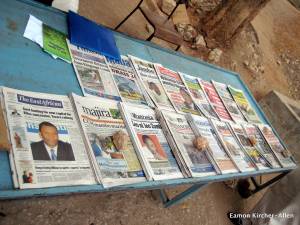
Swahili newspapers for sale on the University of Dar es Salaam campus.
DAR ES SALAAM, Tanzania — Swahili, the language that blossomed hundreds of years ago on the trade winds of the Indian Ocean, splashed into the internet age this June with the launching of the Swahili version of Facebook.
It was only the latest boost for one of the world’s most broadly spoken indigenous African languages. Swahili’s caretakers — academics, writers, researchers and politicians — have long dedicated themselves to keeping the language relevant in times of quickly changing technology.
Nowhere is better suited to lead Swahili into the electronic era than Tanzania, the most thoroughly Swahili-speaking country in the world. A steady stream of foreigners comes to Tanzania to study the language, called Kiswahili by its native speakers. In 2004, researchers at the University of Dar es Salaam helped launch Jambo OpenOffice, an open-source Swahili office suite for the Linux operating system. Swahili literature and newspapers in Tanzania are thriving. Continue reading…
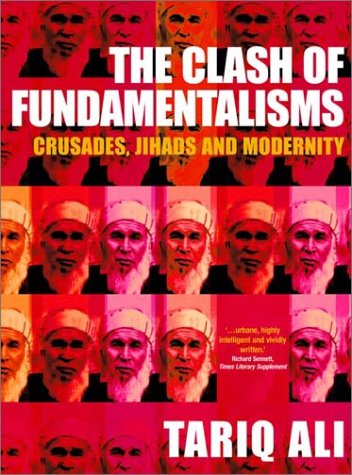
This passage from Tariq Ali’s Clash of Fundamentalisms — I don’t know why I didn’t read this book earlier — has me feeling like Dewey Cox (i.e., guilty as charged).
The ideological dominance of the United States, backed by its military ascendancy, has now grown so pronounced that many of those who were once critical of the way this power was used are reduced to fond purring and trite eulogies. Sweeping generalisations are drawn from incidental or trivial occurrences, and many leading American and supporting European journalists have abandoned unbiased observation and independent thinking in favour of an imperial superpatriotism. US pundits are forever on the lookout for evidence that things are worse abroad than at home, and reporting from the various outposts of the Empire — London, Sarajevo, Riyadh, Cairo, Lahore, Seoul, Tokyo — they yearn in chorus for the familiar American reality they have left behind.
I’ve bolded the last sentence there because I think it’s the one that I — and anyone reporting from other countries — needs to be most wary about it. I’ve been reporting a tech story about the new fiber-optic cable connecting East Africa to the world, and it’s easy to get sucked into the idea that what the region should be aiming for is to replicate the U.S. model of an information society. Not necessarily true. (I like to think the allegations of blind superpatriotism don’t apply to me though!)
But I think about the Internet in those terms all the time: “Why, oh why, can’t it be more like home?” So, good morning, Your Honor. May I approach the bench?
(This post is also an excuse to link to this awesome song from the movie Walk Hard.)
If you care about Iran and the Muslim world, you are going to want to add this to your RSS feeds: Qizilbash, the new blog from a friend at http://qbash.tumblr.com/. From a friend who has been putting all kinds of original media and insights about Iran on Facebook, and I’m glad those’ll be coming to the wider world.
I only had to see five minutes of the History Channel’s new “reality” show, Expedition Africa, to know something was seriously wrong. The show sends four Americans to follow in the steps of 19th Century explorers Henry Morton Stanley and David Livingstone, who opened up the interior of Africa to European exploitation.
The first episode opens with a montage of the four American adventurers whom the show follows through “wild Africa” exclaiming their enthusiasm for traveling in the footsteps of Stanley, who they say was a “hero” and the “the ultimate explorer.” Their goal is to “resurrect the spirit of Stanley.” These clips are spliced with scenes of African animals and (in another segment) clips of a couple of tribespeople. Then, the narrator takes us to “the exotic island of Zanzibar” with “its clear beautiful water and dark past … as the Mecca of the Arab slave trade.” (Cue image of dusky woman in a niqab and statues of Africans chained together by their necks. Then more shots of crocodiles and snakes.) Continue reading →
After I wrote the Huffington Post piece on the John Prendergast-Mahmood Mamdani debate, I sort of felt like pro-Prendergast bloggers thought their man was under attack for no reason. It’s not that he always gets everything wrong, though–and that wasn’t the point of my article. For example, I like this CSM column on being a conscious electronics consumer so you don’t inadvertently contribute to conflict in the Congo. Continue reading →
Here’s an email I received from a friend who works in Web promotion, in response to the sentiments expressed in my last post about finally succumbing to Twitter. He’s on point, and I’m just glad I’m not the dude he describes in the first graf (right? fellas?):
“All this social networking is annoying because most people don’t have shit to say. They have no draw, no product, no expertise in anything, they aren’t funny, they offer no insight and no one cares about their stupid lives. They’re yelling into the void and hoping that if they yell loud enough and often enough someone will pay attention. People try to offer themselves as the draw but if their personality were that magnetic they probably wouldn’t be spending so much time on the Internet in the first place. Continue reading →


 Eamon Kircher-Allen