Context be damned: reactions against Saviors and Survivors from the R2P camp

As an eighth-grader learning about American slavery, I had a fantasy. I imagined that some elite Marines and I could outfit ourselves in the latest combat gear and travel back in time to the year 1820. Once we arrived in the heart of the slavery era, we’d storm the plantations with superior weaponry and free the slaves. Problem solved. It would be awesome, and I’d be a hero.

Of course, as I learned in later study, the abolition of one of history’s most monstrous atrocities was not such a simple matter. Dismantling slavery meant the splitting of a nation, a civil war that sacrificed 600,000 lives, and a burning of the South that – while possibly justified – entailed extreme and morally repugnant violence. And of course, war was only part of the solution. There were the complex political negotiations, the recalibration of society that, 150 years later, is still incomplete.

I kept thinking of these episodes in my education as I read Richard Just’s August 27 take-down of Mahmood Mamdani in The New Republic. The article – a review of Mamdani’s Saviors and Survivors and Gareth Evans’s The Responsibility to Protect – concludes that Mamdani’s book is a paranoid failure, but that Evans proposes a refreshing idealism (though Just finds that the R2P proponent is a little too conservative in promoting his doctrine).

Continue reading

Tanzania’s huge foreign aid flow

During my daily perusing of the Save Darfur Accountability Project (a funny, irreverent and important blog that I urge you to add to your RSS feeds), I saw this graphic of the top world aid donors and recipients. SDAP’s post is intended to show that, contrary to Save Darfur’s arguments that the United States is neglecting Sudan, Washington actually gives more aid to Sudan than any country besides Iraq and Afghanistan. Here’s the image, originally from visualeconomics.com:

Point well taken. But what also caught my eye is that peaceful and stable Tanzania receives, according to this graphic, more development aid than any at-peace country in the world.

Without discounting the basic lacks that lie behind the build up in aid, I have to wonder what that does to an economy and to a society. (Why do I keep having images of Bone Thugs-N-Harmony’s “First of the Month” video, about minute 2:30, flash through my head?) I also have to wonder how much of that money goes to buy these NGO-logo-emblazoned Landcruisers tooling around Dar es Salaam and depositing people at fancy hotels for overpriced drinks.

Anyone know where I can get copies of Dead Aid and The White Man’s Burden in TZ?

State Department travel warnings on Zanzibar

Danger!!!!!

Danger!!!!!

A U.S. State Department warning about travel to Zanzibar and Pemba arrived in my inbox a couple of days ago.

I’ve always thought that the travel warnings issued by the U.S. State Department were a bit like the “Just Say No” anti-drug campaign on which we Eighties Babies were raised. Neither warning systems seem to distinguish between grave and moderate dangers, which tend to make them useless as sources of information. Continue reading

Swahili swerves into the internet age

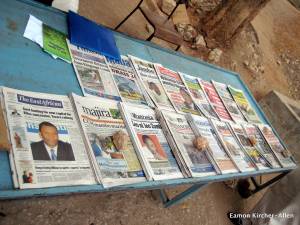
IMG_4890

Swahili newspapers for sale on the University of Dar es Salaam campus.

DAR ES SALAAM, Tanzania — Swahili, the language that blossomed hundreds of years ago on the trade winds of the Indian Ocean, splashed into the internet age this June with the launching of the Swahili version of Facebook.

It was only the latest boost for one of the world’s most broadly spoken indigenous African languages. Swahili’s caretakers — academics, writers, researchers and politicians — have long dedicated themselves to keeping the language relevant in times of quickly changing technology.

Nowhere is better suited to lead Swahili into the electronic era than Tanzania, the most thoroughly Swahili-speaking country in the world. A steady stream of foreigners comes to Tanzania to study the language, called Kiswahili by its native speakers. In 2004, researchers at the University of Dar es Salaam helped launch Jambo OpenOffice, an open-source Swahili office suite for the Linux operating system. Swahili literature and newspapers in Tanzania are thriving. Continue reading…

The politics of a Swahili identity

If you’ve been in Tanzania, you’ve probably heard some foreigner say something to this effect: The reason that Tanzania lags behind in some areas is that the kids learn Swahili instead of English.

Mwalimu Julius Nyerere

Mwalimu Julius Nyerere

On the surface, this makes at least some amount of sense. It may be (let me rephrase: it is) completely unfair and the result of a history of imperialism and exploitation, but nevertheless ignorance of English is a huge handicap if you want to get keyed into the global economy these days. More than that: English, this crappy, haphazard mongrel of a language, represents power. Without it, you are weak, vis-à-vis the rest of the world. And many Tanzanians struggle with English. Continue reading

East Africa gets wired

My story on the new fiber optic cable connecting East Africa to the world went up today on GlobalPost:

DAR ES SALAAM, Tanzania — Ramadhan Mubarak shook his head as he gestured to his six forlorn PCs.

“I believe that many people want to use the internet,” he said. “But most Tanzanians are poor, so they can’t manage the cost.”

Mubarak owns two of the handful of internet cafes in downtown Dar es Salaam, and he can barely cover his overhead of $1,500 a month. Like many people here, he’s hoping that will soon change: East Africa’s new fiber-optic cable has been laid across the Indian Ocean and made landfall here on July 23. When it goes into use in late August, it is likely to dramatically reduce costs and improve connectivity speed. Continue reading…
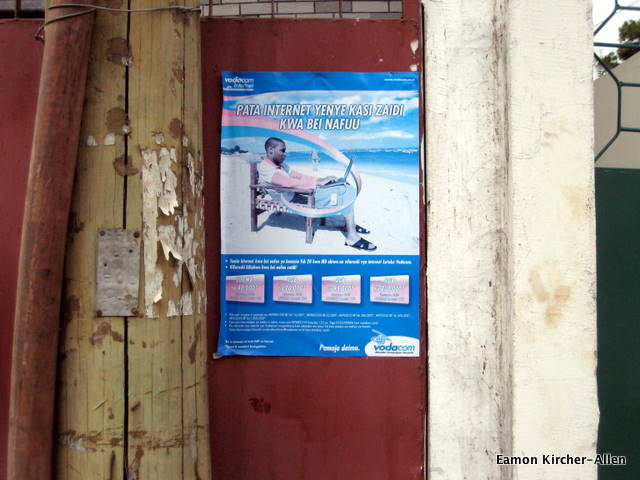
pre-cable internet ad

Crossroads of the Indian Ocean

I spent the weekend in Zanzibar. It’s a place with streets like Damascus, music like Cairo and Congo intertwined, and an equatorial climate. It’s perched on the rim of the Indian ocean, ringed in palms, and everywhere bears the imprint of a history equal parts East Africa and Arabia, with plenty of Persian, Gujarati and other Indian Ocean ingredients thrown in. And I even found a band of roving, self-taught capoeiristas. They call themselves the Spartans (which means they have a link to my Guerreiros in New York, more on that later).

So yeah, you could pretty much say I’m in love. Not much time to write now, but here are just a few photos. I didn’t take many, because I hope to go back soon with more time for impressions.

The streets of Stonetown reminded me of Aleppo.

The streets of Stonetown reminded me of Aleppo.

Continue reading

God make me funky (music break)

I first saw this video back in the states, but due to some derision heaped on it by a certain Kenyan acquaintance, I didn’t pay much attention to it.

But when I saw it playing over the counter at the local restaurant here in Dar (same place I got that pilau nyama that I posted a picture of a few days ago), it took on a different significance. It probably helped that the sound wasn’t  up too high — I’m not giving Radio and Weasel an A+ for lyrics (and I think they only get like a B+ for outfits — it looks like The Pack jumped in a transmogrifying machine with a random Williamsburg hipster, and all elements of both’s clothing were preserved when they came out).

But the dance moves… The dancing had me feeling like The Headhunters singing God Make Me Funky: if I could move like that, well, I don’t think I’d care about too much else.

You know some people pray for wealth
But I don’t even want my health
And when I get on my knees to pray
Well the only thing that I can say:
God, God… God make me funky!

Here you go, “Bread and Butter” by Radio and Weasel:

(All my friends can calm down: I’m not trying this in public any time soon. I reserve the right to attempt it in the privacy of my home, however.)