If you’ve been in Tanzania, you’ve probably heard some foreigner say something to this effect: The reason that Tanzania lags behind in some areas is that the kids learn Swahili instead of English.
Mwalimu Julius Nyerere
On the surface, this makes at least some amount of sense. It may be (let me rephrase: it is) completely unfair and the result of a history of imperialism and exploitation, but nevertheless ignorance of English is a huge handicap if you want to get keyed into the global economy these days. More than that: English, this crappy, haphazard mongrel of a language, represents power. Without it, you are weak, vis-à-vis the rest of the world. And many Tanzanians struggle with English. Continue reading →
My story on the new fiber optic cable connecting East Africa to the world went up today on GlobalPost:
DAR ES SALAAM, Tanzania — Ramadhan Mubarak shook his head as he gestured to his six forlorn PCs.
“I believe that many people want to use the internet,” he said. “But most Tanzanians are poor, so they can’t manage the cost.”
Mubarak owns two of the handful of internet cafes in downtown Dar es Salaam, and he can barely cover his overhead of $1,500 a month. Like many people here, he’s hoping that will soon change: East Africa’s new fiber-optic cable has been laid across the Indian Ocean and made landfall here on July 23. When it goes into use in late August, it is likely to dramatically reduce costs and improve connectivity speed. Continue reading…
I spent the weekend in Zanzibar. It’s a place with streets like Damascus, music like Cairo and Congo intertwined, and an equatorial climate. It’s perched on the rim of the Indian ocean, ringed in palms, and everywhere bears the imprint of a history equal parts East Africa and Arabia, with plenty of Persian, Gujarati and other Indian Ocean ingredients thrown in. And I even found a band of roving, self-taught capoeiristas. They call themselves the Spartans (which means they have a link to my Guerreiros in New York, more on that later).
So yeah, you could pretty much say I’m in love. Not much time to write now, but here are just a few photos. I didn’t take many, because I hope to go back soon with more time for impressions.
I first saw this video back in the states, but due to some derision heaped on it by a certain Kenyan acquaintance, I didn’t pay much attention to it.
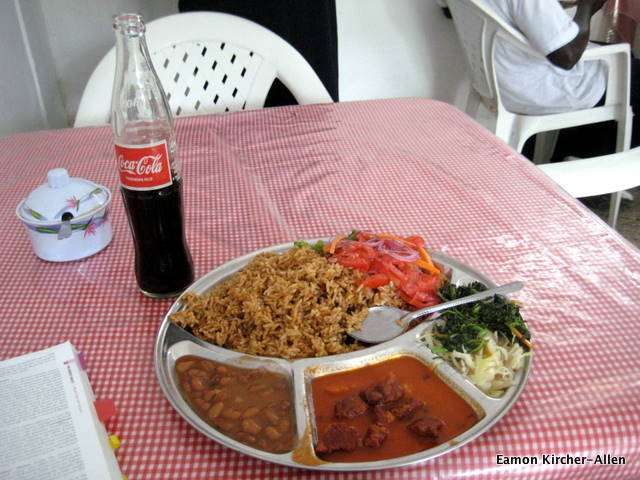
But when I saw it playing over the counter at the local restaurant here in Dar (same place I got that pilau nyama that I posted a picture of a few days ago), it took on a different significance. It probably helped that the sound wasn’t up too high — I’m not giving Radio and Weasel an A+ for lyrics (and I think they only get like a B+ for outfits — it looks like The Pack jumped in a transmogrifying machine with a random Williamsburg hipster, and all elements of both’s clothing were preserved when they came out).
But the dance moves… The dancing had me feeling like The Headhunters singing God Make Me Funky: if I could move like that, well, I don’t think I’d care about too much else.
You know some people pray for wealth
But I don’t even want my health
And when I get on my knees to pray
Well the only thing that I can say:
God, God… God make me funky!
Here you go, “Bread and Butter” by Radio and Weasel:
(All my friends can calm down: I’m not trying this in public any time soon. I reserve the right to attempt it in the privacy of my home, however.)
Andrew Higgins’s story yesterday in the Washington Postabout Herve Jaubert’s escape from Dubai reads like something out of a Tintin comic: mysterious international wealthy people, treacherous sheikhs, PG-13 violence. Jaubert’s story is offered as an example of the growing number of rich Dubai expats who are running into trouble with the country’s police over business crimes. After their investments with his company went sour, Dubai authorities apparently accused Jaubert — “a French spy who left espionage to make leisure submarines for the wealthy” — of embezzlement. They allegedly threatened him with torture (Jaubert recorded the conversation on his cell phone) and confiscated his passport. So Jaubert decided to escape. He donned an all-black diving outfit, snuck out to the bay in the dead of night disguised in an abaya, swam to and disabled a police patrol boat, rode a rubber dinghy to a sailboat where a friend waited, and sailed to India.
Tell me that doesn’t sound like a plot from Tintin and the Golden Dhow. I mean, how many times have Thomson and Thompson, Professor Calculus or Tintin himself used an abaya as a disguise? And take a look at the lead shot of Jaubert. He looks like he could be a colleague of Rastapopoulos. Continue reading →
I love the dhow. It’s the culprit behind all the rich, centuries-long cultural mixing from Tanzania to Yemen to Iran to India. And I love the fact it still coexists with those tall buildings in the background, which are somewhere north of Dar es Salaam.
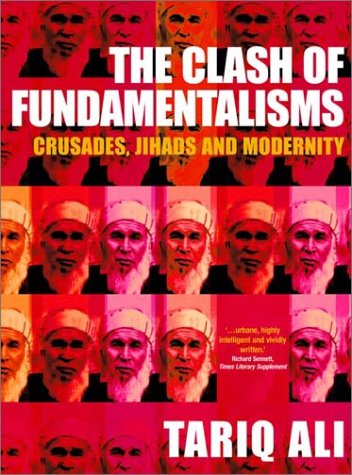
This passage from Tariq Ali’s Clash of Fundamentalisms — I don’t know why I didn’t read this book earlier — has me feeling like Dewey Cox (i.e., guilty as charged).
The ideological dominance of the United States, backed by its military ascendancy, has now grown so pronounced that many of those who were once critical of the way this power was used are reduced to fond purring and trite eulogies. Sweeping generalisations are drawn from incidental or trivial occurrences, and many leading American and supporting European journalists have abandoned unbiased observation and independent thinking in favour of an imperial superpatriotism. US pundits are forever on the lookout for evidence that things are worse abroad than at home, and reporting from the various outposts of the Empire — London, Sarajevo, Riyadh, Cairo, Lahore, Seoul, Tokyo — they yearn in chorus for the familiar American reality they have left behind.
I’ve bolded the last sentence there because I think it’s the one that I — and anyone reporting from other countries — needs to be most wary about it. I’ve been reporting a tech story about the new fiber-optic cable connecting East Africa to the world, and it’s easy to get sucked into the idea that what the region should be aiming for is to replicate the U.S. model of an information society. Not necessarily true. (I like to think the allegations of blind superpatriotism don’t apply to me though!)
But I think about the Internet in those terms all the time: “Why, oh why, can’t it be more like home?” So, good morning, Your Honor. May I approach the bench?
(This post is also an excuse to link to this awesome song from the movie Walk Hard.)
Let no one say that the debate around the U.S. response to Darfur is purely an academic exercise. I have no idea if Sudan Special Envoy Scott Gration has been reading Alex de Waal’s blog at the Social Science Research Council (he should be), but in the congressional hearings last week, we saw the issues haggled over and analyzed to the minutest detail on the SSRC blog start to take on the dimensions of real life consequences.
Check out the Enough blog for its painstaking chronicling of the mainstream response to Gration’s comments that Sudan’s listing as a state sponsor of terrorism is a “political decision” and that the designation of genocide may no longer be relevant. (Enough’s coverage is of course decidedly skewed against Gration. I’m pretty impressed. Until countries like Israel and Saudia Arabia — heck, even us — are listed as state sponsors of terrorism, any such designation is purely political.)
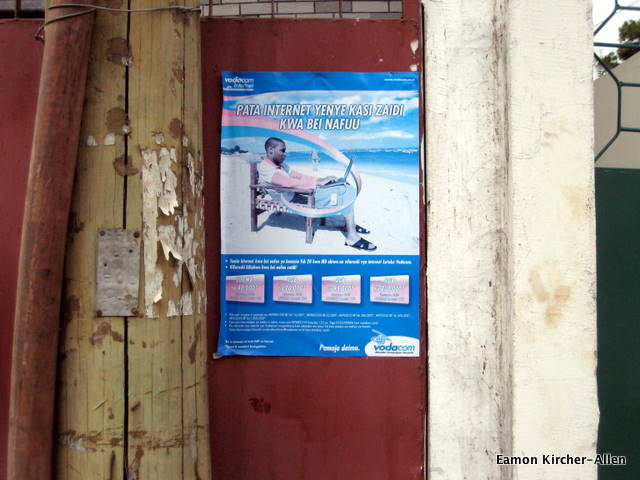
A new arrival to Dar could be forgiven for thinking that the men dressed in red checked and purple robes, white sandals and beaded anklets are wearing costumes for the benefit of tourists. (I’ve heard other people suggest this and, alas, the thought crossed my mind as well.) The Maasai are such symbols of the tourist industry here — and even have some kind of advertising cache inside the country, as the billboard below shows — that at first, it’s easy to doubt that people are going around dressed like that just because they want to.





 Eamon Kircher-Allen
